



By Marc Cameron, Algeos
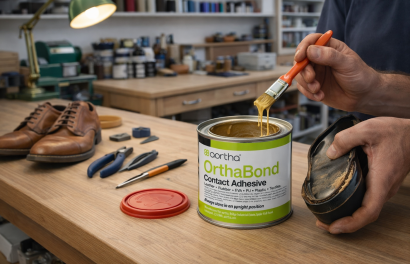
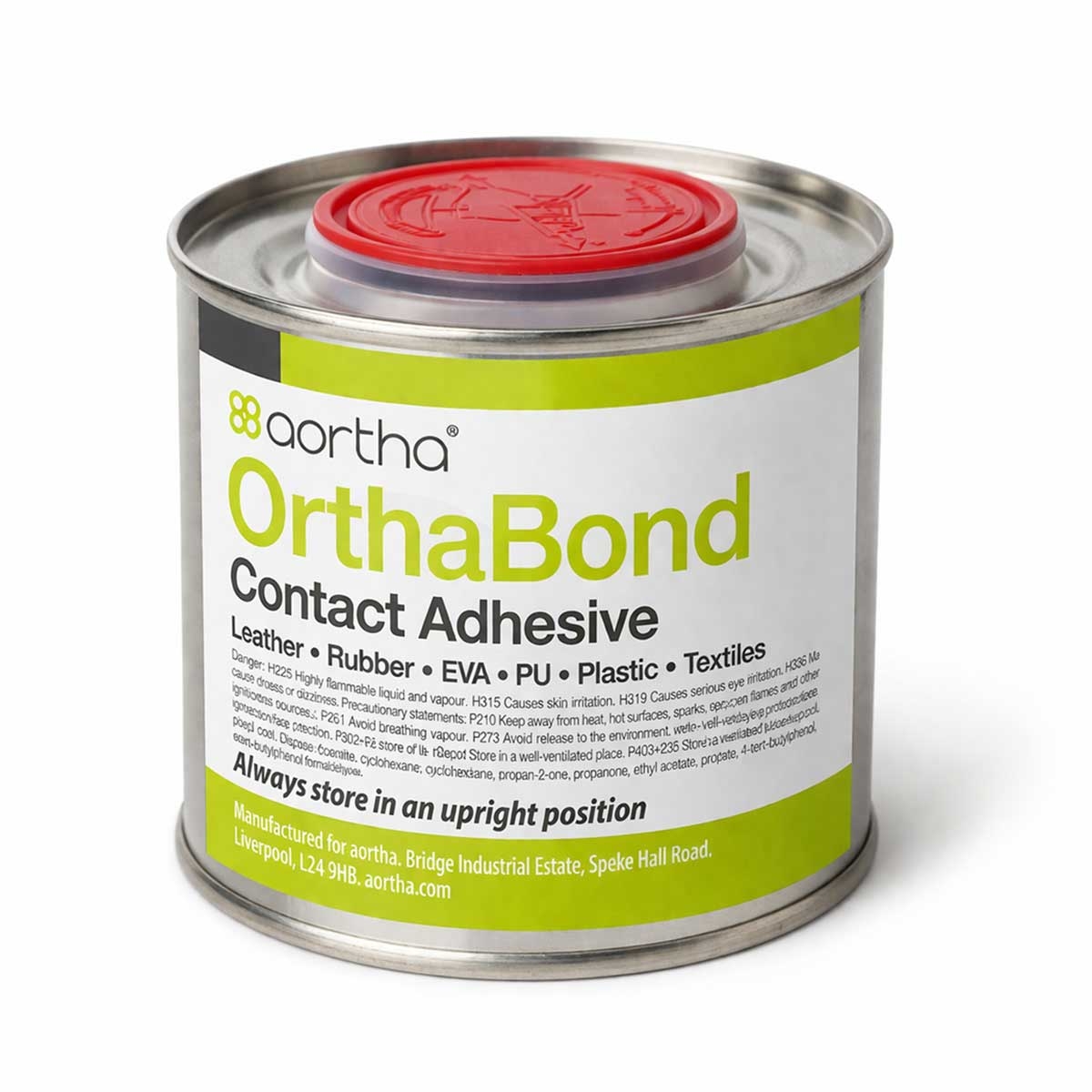
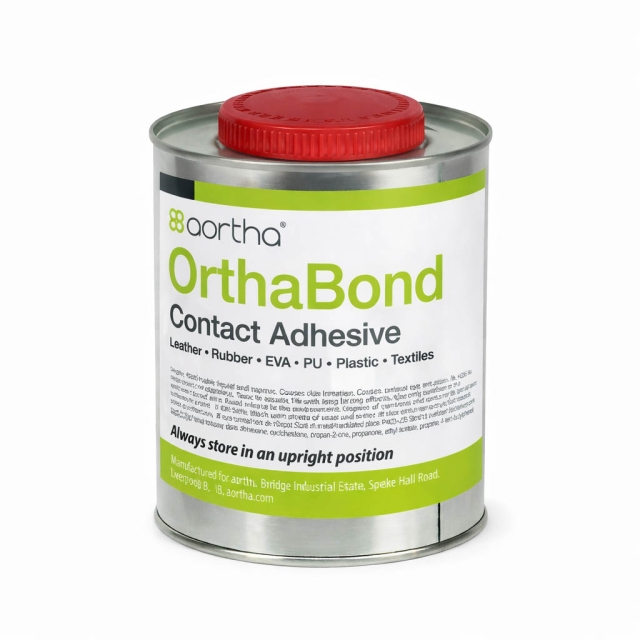
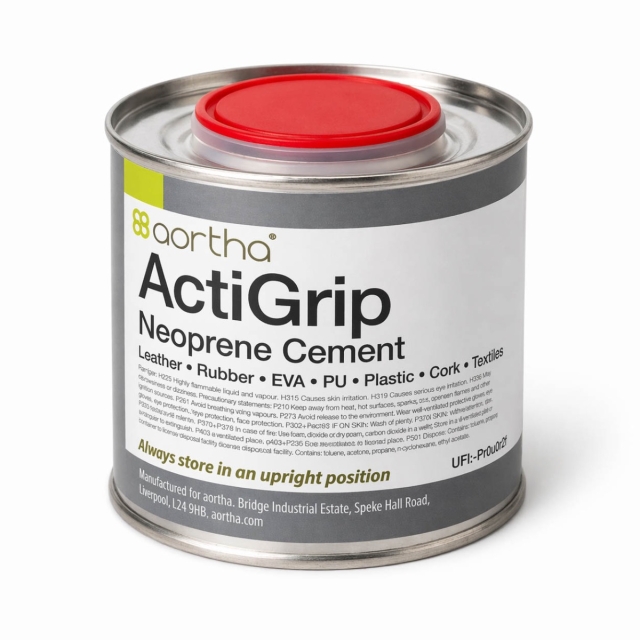
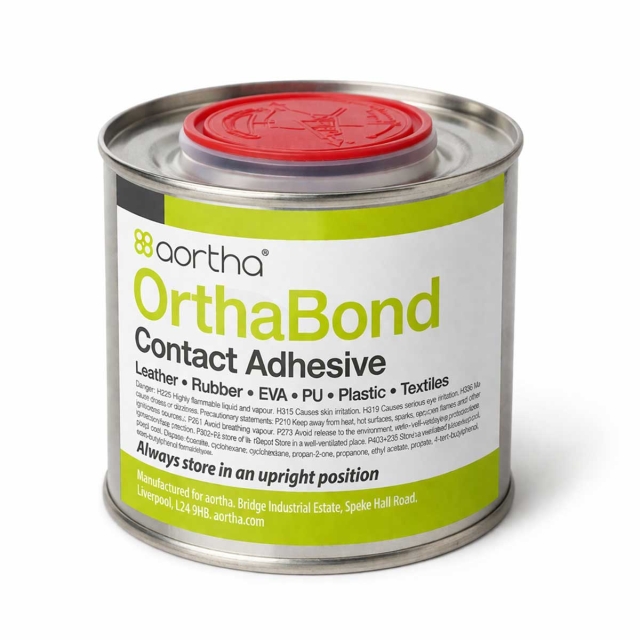
A smaller 500ml tin gives Orthabond a more practical format for home shoe repairs, occasional workshop jobs and users who want professional-grade bonding without committing to a larger container.
Introduction
Orthabond has built a strong reputation with cobblers, repairers and workshop users because it delivers the kind of flexible permanent bond that footwear repairs actually need. Now, with the arrival of the new 500ml tin, the product becomes easier to justify for smaller jobs, lighter usage and home repairs where a full litre can feel excessive.
That matters because many adhesive buyers do not need trade volumes. They need enough product for a few reliable repairs, not a tin that sits on a shelf for months between uses.
Definition
Orthabond Contact Adhesive is a polychloroprene (neoprene) contact adhesive designed for permanent bonding across materials such as leather, rubber, foam, EVA, cork, textiles and certain plastics. It is applied to both surfaces, allowed to tack off and then pressed together to form an immediate bond.
Why this launch matters
The 500ml product page positions Orthabond as a high-strength contact adhesive for demanding professional use, with a working dry time of just over 15 minutes and a strong permanent bond across a wide range of materials.
The technical sheet adds important context: the formula is toluene-free, n-hexane-free, offers good temperature resistance and is intended for materials commonly found in footwear and repair work including EVA, leather, rubber, PU and cork.
Those are exactly the performance markers that matter when the job involves soles, midsoles, heel blocks or flexible upper materials.
The new size also closes a gap in the range. Orthabond has been available in 1L and 5L formats, which suit regular bench use and trade environments. A 500ml option makes the same adhesive more accessible to lower-volume users who still want a workshop-grade result.
That includes people repairing one or two pairs of shoes at home, mobile repair businesses, craft users and clinicians or technicians who only need adhesive periodically.
How Orthabond works
Contact adhesive works differently from glues that need clamping and curing under pressure for long periods. You prepare both surfaces, apply a thin even coat to each side, allow the solvent to flash off and then press the parts together. Orthabond’s technical guidance gives around 15 minutes as a general tack time, with maximum adhesion reached after 24 hours.
Because the bond forms on contact, it is especially useful where you need fast, controlled positioning on footwear components that may not clamp neatly.
In practical terms, that makes it well suited to common shoe-repair scenarios such as re-bonding loose soles, repairing separated edges, fixing leather overlays and bonding foam or rubber layers. Once cured, the adhesive remains flexible rather than glass-hard. That flexibility is crucial because shoes bend, twist and absorb repeated impact every day.
Roughen surface → Clean away dust → Apply thin coat to both surfaces → Wait roughly 15 minutes → Press firmly together → Leave up to 24 hours for full strength
What users say about Orthabond
There is good evidence that Orthabond is more than a niche workshop adhesive. On Amazon UK, the 1 litre listing shows a 4.4 out of 5 rating from 208 reviews, while the 5 litre listing shows 3.6 out of 5 from 7 ratings. Amazon also flags the 1 litre version as an Amazon’s Choice product and notes recent purchase activity.
That does not prove market leadership across the whole UK category, but it does support the case that Orthabond is a widely bought and positively reviewed contact adhesive in the UK market.
Algeos also leans into review-backed positioning in its recent guide to Orthabond, citing strong customer feedback and highlighting the adhesive’s repeatable performance on shoes, leather, rubber and foams. From an editorial point of view, the more useful takeaway is not the slogan. It is the pattern behind it: users appear to value predictable tack time, durable bonding and versatility across several repair materials rather than a one-use-only niche glue.
For home shoe repairers, that combination is appealing. A product trusted by trade users often feels more forgiving than bargain glues sold on speed alone. The working time is long enough to prepare properly and the bond is designed for movement, which is far more relevant to footwear than sheer instant grab.
Why the 500ml tin is especially useful for home shoe repairs
The biggest advantage of the smaller tin is simple: less waste risk. Orthabond’s technical sheet states a stability period of around 6 months when stored in well-sealed packaging in a cool dry place. For a professional user, a litre or 5 litres may be used quickly enough to make perfect sense. For a household user repairing trainers, boots, sandals or an occasional leather item, 500ml is a more realistic amount to buy and keep fresh.
The second benefit is lower entry cost. The live Algeos product pages show the 500ml tin at £9.60 inc VAT and the 1 litre tin at £10.80 inc VAT. That narrow price gap is notable because it gives buyers a genuine choice: maximum volume per pound for regular use, or a smaller tin for convenience and storage without a major financial penalty. For occasional users, the 500ml size is easier to justify because it reduces overbuying and still gives plenty of adhesive for multiple repairs.
The third benefit is handling. A smaller tin is easier to store in a home workshop, simpler to transport and arguably less intimidating for first-time repairers. That matters more than many brands admit. People are more likely to attempt a careful sole repair when the product feels manageable and appropriately sized for domestic use.
Size comparison at a glance
| Pack size | Best for | Live price shown | Key consideration |
|---|---|---|---|
| 500ml | Home shoe repairs, lower-volume users, occasional workshop tasks | £9.60 inc VAT | Better fit for occasional use and easier storage |
| 1 litre | Regular repairers, busy workshops, repeat use | £10.80 inc VAT | Best value per volume for users who get through adhesive quickly |
| 5 litres | Trade environments and high-throughput manufacturing | £49.66 inc VAT | Suited to professional demand and bulk use |
Step-by-step guide for repairing shoes at home
- Inspect the failure. Orthabond is most suitable when the issue is a clean separation between materials such as sole-to-upper, rubber-to-leather or foam-to-foam.
- Prepare the surfaces. Roughen both sides lightly with abrasive paper to improve surface area and remove weak old residue.
- Clean thoroughly. Dust, fibres and greasy contamination reduce adhesion.
- Apply a thin even coat to both surfaces. Avoid flooding the area.
- Wait for tack-off. Around 15 minutes is the general guide, though conditions and materials can change this.
- Join carefully. Once the surfaces touch, the bond forms immediately, so alignment matters.
- Press firmly. The technical guidance recommends holding for about 1 minute.
- Allow full cure time. Although the bond is immediate, leave up to 24 hours before hard wear where possible.
For occasional home users, this is exactly where the 500ml tin makes sense. It gives enough product for repeated attempts and future repairs without forcing you into trade-volume buying.
Related pages
FAQ
Is the 500ml tin enough for more than one shoe repair?
Yes. For most home users, 500ml is likely to cover multiple repairs, especially when the adhesive is applied in thin even coats rather than thick layers.
What materials can Orthabond bond?
The technical guidance lists EVA, leather, rubber, PU, cork, PVC (hardened), PPC and PE, and Algeos also describes use across foam, plastics, wood and textiles.
Is Orthabond suitable for home users?
It can be suitable for informed home users, especially for shoe repairs, but it should be used carefully in a well-ventilated space and with proper surface preparation.
How long should I wait before wearing repaired shoes?
The bond forms on contact after tack-off, but full adhesion is reached after about 24 hours, so waiting a full day is the safer approach for hard-wearing repairs.
Why choose 500ml over 1 litre?
Choose 500ml if you repair shoes only occasionally, want easier storage or prefer to reduce the risk of product ageing before the tin is fully used.
Is Orthabond really one of the UK’s most popular contact adhesives?
The strongest public signal is the Amazon UK listing, where the 1 litre version shows 208 reviews and a 4.4 out of 5 rating. That supports strong popularity, even if exact nationwide market-share data is not publicly available.
References and research sources
- Algeos - Orthabond Contact Adhesive Glue 500ml
- Algeos - Orthabond Contact Adhesive Glue 1 Litre
- Algeos - Orthabond Contact Adhesive Glue 5 Litres
- Aortha - OrthaBond Spec Sheet PDF
- Algeos guide - Why Orthabond is our Best Shoe Glue
- Amazon UK - OrthaBond Contact Adhesive 1 Litre
- Amazon UK - OrthaBond Contact Adhesive 5 Litre
Author bio
Marc Cameron writes practical product and clinical guides for Algeos, with a focus on orthotic materials, workshop processes, footwear repair and evidence-led product selection. His articles are designed to be useful to clinicians, technicians and informed consumers alike.
Sold: 500ml
Incl. VAT Exl. VAT