



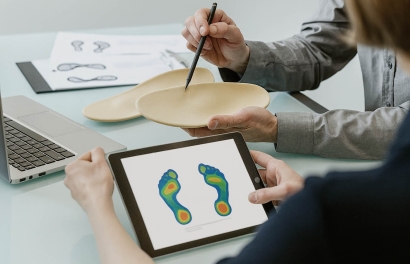
3D printed orthotics have entered mainstream podiatric practice faster than almost any previous technology. Many clinics are now asking the same question: are they genuinely worth the extra upfront cost?
This guide analyses clinical impact, workflow efficiency and true return on investment to help podiatrists decide with confidence.
Definition
3D printed foot orthotics are custom foot devices produced using additive manufacturing. Instead of milling a block of material, a digital model is printed layer by layer using polymers or composites to achieve consistent, repeatable and highly tailored mechanical properties.
How 3D printing works and why it matters
3D printed orthotics begin with a digital foot capture (scanner or gait plate) which creates a precise model of the foot. CAD software is used to design the device, adjusting shell thickness, stiffness zones and anatomical features.
The design is printed using selective laser sintering or fused deposition modelling, followed by finishing and posting. The result is a device with measurable mechanical precision and less material waste.
Why this matters clinically is simple: the design features that influence comfort and mechanics can be standardised more reliably than with traditional vacuum or milling techniques. Many podiatrists report fewer remakes, more predictable outcomes and improved patient acceptance.
From an operational perspective the benefits are equally strong. Digital workflows reduce storage, reduce human handling error and allow rapid duplication or design updates without rescasting a patient.
What podiatrists say
Most clinicians who adopt 3D printing describe two early observations: patients respond positively to the modern aesthetics and the fit precision is noticeable from the first wear. The biggest change is consistency.
Once a clinic settles on preferred design libraries, it becomes possible to reproduce the same mechanical intent for different patients without variation caused by hand finishing or manual posting.
Clinicians who have run digital systems for several years often report that 3D printing becomes more cost effective over time because adjustments and remakes reduce, and digital files form a usable patient archive. However experienced practitioners also note that success depends on choosing a reliable lab partner and ensuring the clinic team understands digital capture technique.
A step by step guide to making 3D printing cost effective in clinic
- Define the clinical cases that benefit most. Midfoot instability, plantar fasciopathy, diabetic offloading and repeat orthotic wearers are high value groups. These patients often appreciate precision shaping and reduced bulk.
- Standardise your assessment to match digital workflows. High quality scans matter more with 3D printing. Train staff on positioning, weight bearing protocols and capture–to–design notes.
- Select a lab that provides design libraries and variable stiffness zones. Podiatrists gain the biggest ROI when they can request predictable characteristics such as graduated stiffness under the midfoot or forefoot posting integrated into the print.
- Set patient expectations at fitting. Emphasise lighter weight, accuracy and the option for rapid replacement. Patients often perceive these devices as premium which can justify appropriate pricing.
- Use digital archives strategically. Repeat orders take seconds, not hours. This is one of the biggest ROI drivers for busy clinics.
- Track remake rates. A drop in remakes is one of the clearest signs 3D devices are paying for themselves. Many clinics report reductions after the first three to six months.
- Integrate performance data into your pricing model. If follow up time decreases and device durability increases, your margin improves. Review device sales and appointment utilisation quarterly.
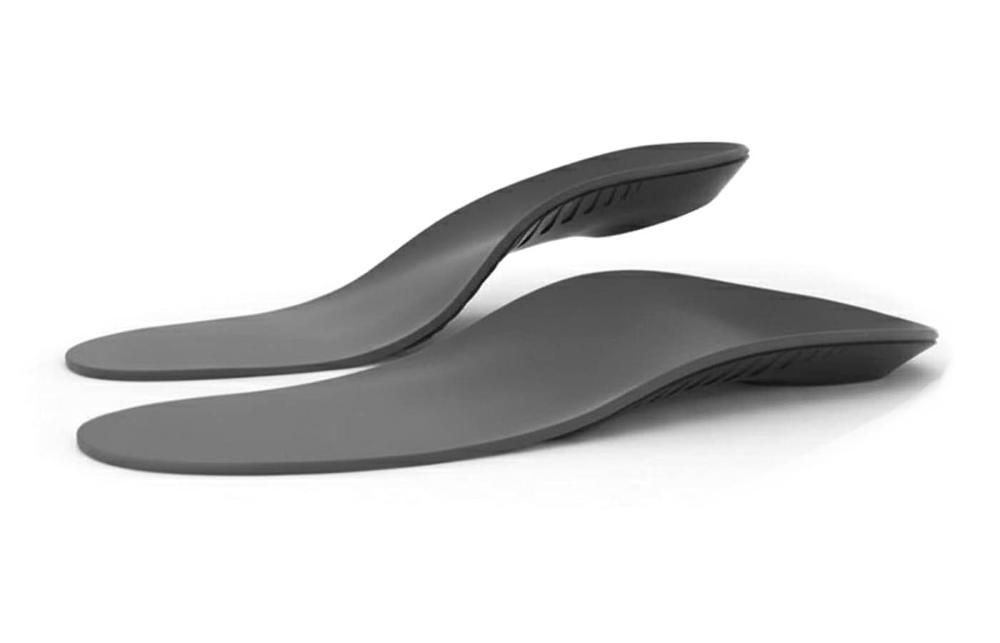
3D Printed Orthotics
Comparison table: 3D printed vs traditional orthotics
| Feature | 3D Printed Orthotics | Traditional Orthotics |
|---|---|---|
| Manufacturing precision | High digital accuracy and repeatability | Variable depending on manual technique |
| Turnaround time | Fast with streamlined workflows | Often longer due to manual steps |
| Material efficiency | Low waste and consistent properties | Higher waste from milling or moulding |
| Remake and adjustment rate | Often lower due to precision | Higher with complex foot types |
| Long term cost effectiveness | Strong when device lifespan is high and remakes drop | Depends heavily on practitioner skill and materials |
FAQ
1. Do 3D printed orthotics last longer?
Many do. Studies on nylon based SLS devices show stable deformation resistance over prolonged loading. Longevity also depends on patient weight, activity and shoe fit.
2. Are they better for complex foot types?
They can be. 3D printing allows targeted stiffness patterns around specific anatomical features which is helpful for cavus feet, midfoot collapse or post surgical foot types.
3. Is the price difference justified?
Often yes when factoring reduced remakes, faster workflows and patient willingness to invest in a premium device. The financial difference also narrows because digital scanning removes several physical manufacturing steps.
4. What is the main barrier to adoption?
Initial cost and training. Clinics need to adopt consistent digital assessment techniques to fully benefit from additive manufacturing accuracy.
5. Do patients perceive 3D printed devices as more comfortable?
Many do. The thinner profile and precise contouring improves shoe accommodation, which is one of the biggest drivers of compliance.
6. Are 3D printed orthotics easier to adjust?
Some adjustments can be made by heat or grinding but most design changes are done digitally and reprinted. Quick reprints can improve turnaround for corrections.
7. Can they reduce clinician workload?
Digitisation often streamlines operations and reduces manual finishing time which can free clinicians for more patient contact or complex cases.
References and research sources
- Almeida H, Lopes P, Silva J et al. 3D printed foot orthoses: A systematic review of biomechanical effects and clinical outcomes. Journal of Foot and Ankle Research. 2023. https://jfootankleres.biomedcentral.com/articles/10.1186/s13047-023-00646-z
- Portnoy S, Mor A, Hetsroni I et al. Patient specific 3D printed orthoses improve comfort and reduce plantar pressure. Gait and Posture. 2022. https://www.sciencedirect.com/science/article/pii/S0966636222001409
- Xu X, Ng S, Awad A. Additive manufacturing in podiatry and orthotics: clinical applications and material behaviour. Medical Engineering and Physics. 2021. https://www.sciencedirect.com/science/article/pii/S1350453321001585
- Schrank ES, Hitch L, Wallace J. Additively manufactured orthoses: evaluating performance and patient response. Prosthetics and Orthotics International. 2019. https://journals.sagepub.com/doi/10.1177/0309364619839263
- Ryan M, Franklyn M. Orthotic durability and deformation: comparison of nylon based additive manufactured devices with traditional polypropylene. Journal of Rehabilitation and Assistive Technologies Engineering. 2020. https://journals.sagepub.com/doi/10.1177/2055668320902960
Sold: 10m Roll
Incl. VAT Exl. VAT