



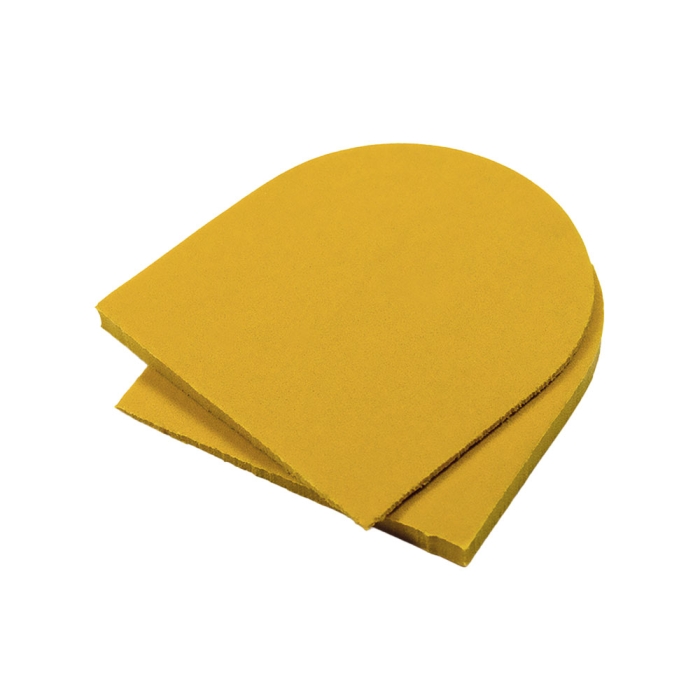
Wedged Heels Posts - Self Adhesive Orthotic Posts
Pre-cut wedged heel posts for orthotic posting.
Speeds up bespoke insole production.
Reduces reliance on manual shaping.
Available in multiple wedge angles.
Sold: Sold in Pairs
Incl. VAT Exl. VAT
Product Description
Rearfoot Posting Wedges for Orthotic Therapy
Pre-cut wedged heel components designed to support efficient rearfoot posting when manufacturing bespoke insoles.
Best for: Clinicians and technicians producing custom orthoses who need a fast, predictable way to introduce rearfoot wedging.
Not ideal for: Direct-to-consumer use where clinical knowledge is not present.
- Pre-shaped for speed and consistency
- Multiple wedge angles available
- Supplied as matched pairs
Expected use timeline
First use: When incorporated into a finished insole, the wedged heel typically feels firm and supportive under the rearfoot. Some users may notice the change in heel alignment immediately, particularly if they are new to posted orthoses.
Short term (first few days): As the foot adapts to the adjusted rearfoot position, mild awareness through the heel or ankle can occur. This is usually related to altered load distribution rather than pressure from the component itself.
Ongoing use (weeks): Once the insole is worn regularly, the wedged heel becomes an unobtrusive structural element within the orthosis, continuing to provide rearfoot control without drawing attention during daily activities.
What is it?
Wedged Heels are pre-cut Podotech components manufactured from medium-density EVA and shaped specifically for rearfoot posting in bespoke insoles. Each heel is already formed to a defined angular wedge, allowing clinicians to add controlled rearfoot correction without the need for extensive grinding or shaping.
The components are supplied as left and right pairs and are intended to be bonded or integrated into custom orthotic builds as part of a professional workflow.
Who is it for?
This product is intended for use by podiatrists, orthotists, and insole technicians involved in the manufacture or modification of custom foot orthoses. It suits clinical environments where efficiency, repeatability, and material reliability are important.
It is not designed for end-user self-fitting and should be used within a structured insole fabrication process.
What does it help with?
- Rearfoot alignment needs: may help introduce controlled angular adjustment at the heel.
- Custom orthotic builds: supports faster assembly when time or equipment is limited.
- Consistent outcomes: helps reduce variability compared to freehand posting.
- Material selection flexibility: offers multiple degrees and colours for easy identification.
How does it work?
The wedged shape alters the interface between the heel and the rest of the orthotic shell. By selecting an appropriate degree of wedge, the clinician can influence how load is distributed through the rearfoot during stance and gait.
The EVA material provides a balance between firmness and workability, allowing the component to maintain its shape under load while still integrating smoothly into layered insole constructions.
Problem and solution overview
| Common problem | How the wedged heel helps |
|---|---|
| Time-consuming rearfoot posting | Pre-cut angles reduce shaping time during insole manufacture. |
| Inconsistent wedge angles | Defined degrees provide predictable and repeatable posting. |
| Material collapse under load | A40–A50 EVA offers a stable yet workable base. |
| Difficulty identifying posts | Colour coding helps distinguish wedge degrees at a glance. |
Key benefits
- Speeds up bespoke insole production
- Reduces reliance on manual shaping
- Available in multiple wedge angles
- Balanced EVA density for clinical use
- Supplied in practical left/right pairs
- Integrates easily into layered orthotic designs
Fit and comfort check
When incorporated correctly, the wedged heel should feel snug and supportive, not painful. Any sense of sharp pressure under the heel usually indicates placement or integration issues rather than an unsuitable wedge angle. Minor adjustments to top covers or surrounding materials can often resolve comfort concerns.
Common mistakes to avoid
- Using a higher wedge degree than clinically indicated
- Assuming immediate comfort without an adaptation period
- Poor bonding or alignment during insole assembly
- Overlooking footwear volume constraints
How to use
- Select the appropriate wedge degree based on your orthotic design requirements.
- Confirm left and right orientation before bonding.
- Integrate the wedged heel into the rearfoot section of the insole base.
- Bond securely using suitable adhesives for EVA materials.
- Finish with top covers or additional layers as required.
Technical specifications
| Product type | Pre-cut rearfoot wedged heel component |
|---|---|
| Available wedge angles | 3°, 4°, 5° |
| Colour options | White (3°), Black (4°), Yellow (5°) |
| Material | EVA (A40–A50 density range) |
| Pack contents | 1 pair of wedged heels |
| Dimensions | Varies by option |
| Care and handling | Store flat, away from excessive heat or compression |
Frequently asked questions
Can these be used on their own inside footwear?
No. These components are intended to be integrated into bespoke insoles and are not designed for standalone use.
How do I choose between 3°, 4°, and 5°?
The choice depends on the level of rearfoot posting required in your orthotic design. Many clinicians use lower degrees for subtle correction and higher degrees where more control is indicated.
Is the EVA soft or firm?
The A40–A50 EVA range provides a medium firmness that balances durability with ease of shaping.
Will these fit all shoe types?
Fit depends on the overall insole thickness and footwear volume. They are commonly used in everyday and clinical footwear with adequate depth.
Can they be ground or modified further?
Yes. While pre-cut, the EVA material can still be adjusted if fine-tuning is required.
Are they supplied as singles or pairs?
They are sold as matched left and right pairs.
Complementary product suggestions
- Custom insole base materials
- Top cover foams and fabrics
- Adhesives suitable for EVA bonding
- Forefoot posting components
Content credibility
Written by: Algeos Product & Clinical Content Team
Last reviewed: January 2026
This content is intended to support informed purchasing decisions and product understanding. It does not provide diagnosis or medical advice.
Frequently bought together
Sold: Each
Incl. VAT Exl. VAT
Sold: Each
Incl. VAT Exl. VAT
Sold: Each
Incl. VAT Exl. VAT
Sold: Pack of 6
Incl. VAT Exl. VAT
Sold: 5 Pairs
Incl. VAT Exl. VAT
Sold: Sold per Pair
Incl. VAT Exl. VAT
Sold: Sold per Pair
Incl. VAT Exl. VAT
Sold: Sold per Pair
Incl. VAT Exl. VAT
Sold: Sold per Pair
Incl. VAT Exl. VAT
Sold: Pack of 10
Incl. VAT Exl. VAT
Sold: Sold per Pair
Incl. VAT Exl. VAT
Sold: Sold per Pair
Incl. VAT Exl. VAT
Sold: Sold per Pair
Incl. VAT Exl. VAT
Sold: Pair
Incl. VAT Exl. VAT
Sold: Sold per Pair
Incl. VAT Exl. VAT
Sold: Sold per Pair
Incl. VAT Exl. VAT
Sold: Sold per Pair
Incl. VAT Exl. VAT
Sold: Sold in Pairs
Incl. VAT Exl. VAT