




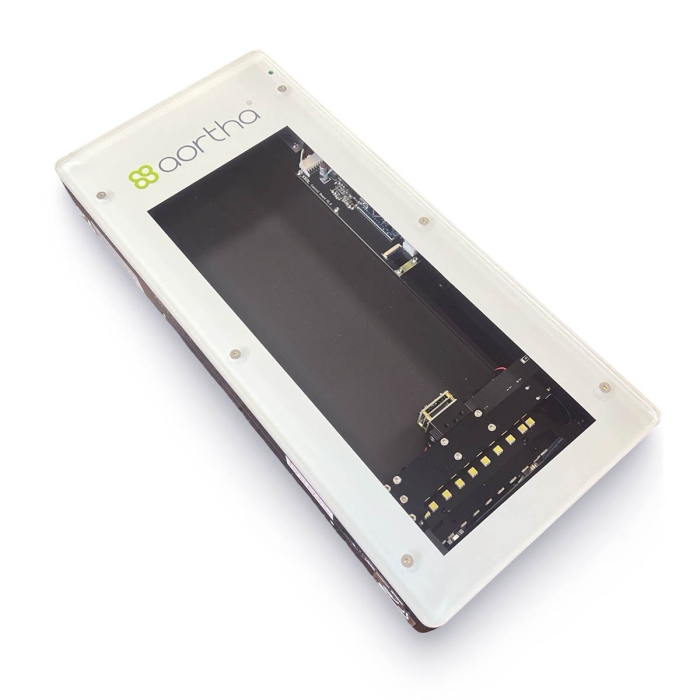
Aortha 3D Laser Foot Scanner
The Aortha 3D Foot Scanner is a strong digital capture system. It is designed for O&P labs, NHS MSK services and busy orthotic fabrication settings.
With rapid scan times, sub-millimetre accuracy and fully open digital exports, it integrates seamlessly into any CAD/CAM or 3D printing workflow.

Product Description
The Aortha 3D Foot Scanner is a precise digital system. It is designed for orthotic labs, NHS MSK teams and clinics. This scanner provides reliable and repeatable digital data for custom foot orthoses. Built on proven laser technology and designed for industrial-level accuracy, the Aortha 3D delivers reliable 3D plantar and foot-shape scanning in seconds—making it ideal for any organisation transitioning from traditional casting to a fully digital workflow.
Whether you operate a high-volume O&P facility, a central fabrication hub, an NHS MSK service, or a podiatry clinic seeking seamless integration into CAD/CAM or additive manufacturing systems, the Aortha 3D Foot Scanner offers the speed, accuracy and interoperability required for modern orthotic production.
Introduction: Designed for Production, Engineered for Accuracy
Orthotic manufacturing is shifting rapidly toward digital efficiency. The Aortha 3D Foot Scanner has been created to support this shift, offering a rugged, repeatable and industry-ready solution for capturing foot geometry with exceptional clarity. Its laser triangulation engine produces dense, clean 3D meshes that integrate directly with all major CAD platforms, 3D-printing pipelines and milling systems.
Unlike mobile apps or consumer-grade depth cameras, the Aortha 3D system is built for clinical and laboratory precision. Its combination of laser scanning, high-resolution colour capture and advanced noise filtering ensures dependable results—whether scanning a patient directly or digitising foam impression boxes and plaster casts within a lab environment.
This makes the scanner highly adaptable across workflows:
- Direct patient scanning in NHS MSK and podiatry clinics
- Foam impression digitisation in O&P central fabrication labs
- Plaster cast digitisation for legacy processes
- High-volume CAD/CAM environments requiring clean meshes
- 3D printing pipelines needing open-format, high-fidelity models
The Aortha 3D is fully open-source in its export capabilities, ensuring no reliance on proprietary ecosystems.
Key Features
1. Dual Scanning Capability for Clinical and Lab Workflows
The Aortha 3D supports both direct patient scanning and foam impression box or plaster cast digitisation, giving complete flexibility across O&P and MSK applications.
This ensures consistent input for any orthotic production setup, including:
- NHS MSK hubs
- O&P central fabrication labs
- Private orthotic manufacturing facilities
- Satellite clinics feeding data to a main lab
Scans can be non-weightbearing, semi-weightbearing or full-weightbearing depending on clinical preference.
2. High-Precision Laser Triangulation
The heart of the Aortha 3D is its advanced laser system:
- 2.0-second one-way laser scan
- 2.0–4.9 seconds colour texture capture
- Sub-millimetre accuracy: ±1.0 mm
- Clean meshes ready for CAD/CAM with minimal post-processing
This level of precision is essential for labs producing 3D-printed or CNC-milled orthoses, where small deviations can significantly impact device performance.
3. Contact-Free Scanning for Hygiene and Accuracy
The scanner uses non-contact laser measurement, ensuring:
- Zero deformation of the foot shape
- Reliable data for high-volume production
- Reduced contamination risk
- Faster turnaround in clinics and labs
For busy services, this translates into efficient throughput without compromising quality.
4. Fully Open, Vendor-Neutral Digital Integration
The Aortha 3D is built to integrate into any orthotic manufacturing workflow.
Export formats include:
- STL
- OBJ
- WRL
- PLY
- JPG/PNG
- CSV (measurement data)
This ensures compatibility with all major CAD/CAM technologies used in O&P production, including:
- Orthotic design CAD platforms
- CNC milling systems
- SLS/SLA/HP MJF 3D-printing workflows
- In-house or outsourced fabrication facilities
This open-format output supports scalable, multi-site environments where data needs to travel efficiently between clinics and labs.
5. Automated Clinical Metrics and Landmark Detection
For NHS MSK clinics, podiatrists and clinical teams, the scanner automatically provides:
- Arch height and arch index
- Heel/leg angle estimations
- Bunion alignment metrics
- Medial/lateral height data
- Shoe sizing predictions across global scales
- Automatic landmark detection with refinement options
This ensures consistent documentation and simplifies communication with orthotic labs.
6. Purpose-Built Scan Modes for Different Surfaces
Four dedicated modes optimise scan quality across materials:
- Bare Foot
- Foot Shape (adjustable exposure for varied skin tones)
- Foam Impression
- Plaster Cast (Internal)
Exposure settings from 1 to 12 allow precise calibration for darker foams or highly reflective casts used in O&P environments.
7. Lightweight, Compact and Lab-Friendly Hardware
With a footprint of just 455L × 212W × 55H mm and weighing 3.2 kg, the Aortha 3D fits comfortably into:
- Production benches
- MSK treatment rooms
- Orthotic assessment bays
- Lab digitisation stations
Despite its compact size, its 180 kg load capacity ensures stability and safe use in clinical settings.
8. Intuitive Controls and Efficient Workflow Tools
The user interface includes:
- Multiple viewing angles (dorsal, plantar, medial, lateral and more)
- Iso-depth, colour and solid rendering modes
- Crop and clean-up functions
- Auto and manual landmarking
- PDF reporting
- Multi-language support
- Customisable UI themes
Controls can be operated via on-screen buttons or a foot switch, ideal for environments where hands-free operation improves workflow efficiency.
9. Engineered for Reliability in High-Usage Environments
The Aortha 3D is built for daily, repeated use in clinical and industrial settings. It features:
- Enhanced lighting noise reduction
- Stable USB connectivity
- Robust data processing under heavy workloads
- Reliable performance in typical clinic/lab ambient lighting
This makes it suitable for central fabrication facilities processing large numbers of scans every week.
Applications
The Aortha 3D Foot Scanner is designed specifically for:
O&P and Orthotic Manufacturing
- High-volume scanning for CAD/CAM workflows
- Digital capture for 3D printing (MJF, SLS, SLA and more)
- Transition away from plaster-based workflows
- Foam impression digitisation for legacy clinics
NHS MSK Departments
- Standardised scanning across multi-clinician teams
- Trust-wide orthotic services and shared protocols
- Integration with existing NHS-approved CAD software
Private MSK, Podiatry and Orthotic Services
- Enhanced data quality for outsourced fabrication
- Clean, fast, and reproducible scans
- Professional reporting for patient-facing documentation
University & Training Centres
- Teaching digital orthotic workflows
- Research on orthotic design and biomechanics
Why O&P and NHS Teams Choose the Aortha 3D
A. Industrial-Grade Consistency
The scanner provides uniform results across clinicians, locations and scanning sessions - critical for multi-site services and central fabrication workflows.
B. Open Ecosystem
No locked software. No proprietary cloud. No forced subscription.
Clinics and labs retain full ownership and flexibility over their scan data.
C. Zero-Mess Digital Workflow
The scanner reduces dependency on:
- Plaster casting and manual impression techniques
- Physical shipment of casts or foam boxes between sites
- Waste materials associated with traditional methods
This improves sustainability and reduces costs across the orthotic supply chain.
D. Fast, Repeatable and Efficient
The Aortha 3D is ideal for high-volume production environments where:
- Every minute matters in the clinical or lab schedule
- Accuracy directly affects fabrication outcomes and remake rates
- Reliable scanning enhances quality assurance and traceability
E. Future-Proof Investment
With universal file compatibility and open API integration, the scanner supports current and future digital processes without limiting technological options. It can evolve alongside your CAD, CAM and additive manufacturing investments, without being tied to a single platform.
Full Technical Specifications
Hardware
- Foot Plantar 3D with colour (non-weightbearing, semi-weightbearing, full-weightbearing)
- Foam impression and plaster cast scan capability
- Laser 3D scan: 2.0 seconds (one-way)
- Colour capture: 2.0–4.9 seconds (standard/high resolution)
- ±1.0 mm accuracy (clean 3D mesh)
- Scan volume: 330L × 140W × 80H mm
- Device size: 455L × 212W × 55H mm
- Weight: 3.2 kg
- Load capacity: 180 kg
- PC requirements: CPU N100, 8GB RAM, 1080p display
- Integrated GPU fully supported
- Scan activation via software UI or foot-switch
- Advanced noise filtering for mixed clinic/lab lighting
- High-resolution heel camera
- Power: AC 100–240V; DC 12V/3A
- Customisable outer panel colours for branding
- One-year limited warranty
Software
- Compatible with Windows 10 and 11 (not compatible with Windows 7/8)
- Auto analysis: arch type, bunion and heel angle
- Auto tracking: metatarsal markers & heel markers
- Editable landmarks via direct manipulation on the 3D model
- PDF reporting with annotation tools
- Clinic-branded report templates and layout control
- UI/theme customisation and multi-language support
- Shoe size outputs (US/UK/EU/CN/JP standards)
- Export to STL / OBJ / WRL / PLY / JPG / PNG / PDF / CSV
- FTP sending functionality to fabrication facilities
- Customisable orthotic RX form for standardised prescriptions
- Developer API (CMD/TCP) for integration into external CAD and database systems
- Optional encryption for file and scanner control
- Supports XSOL, USOL and DUO family scanners alongside Aortha 3D use-cases
Clinical & Production Workflow: What This Looks Like in Practice
A typical workflow using the Aortha 3D Foot Scanner might follow these steps:
- Select scan mode
Choose Bare Foot, Foot Shape, Foam Impression or Plaster Cast according to your clinical or production objective and preferred technique. - Position the subject or model
For clinical use, centre the heel and align the foot along the scanner axis. For lab use, position the foam impression or cast securely with appropriate orientation. - Capture the scan
Trigger the scan via on-screen controls or the foot switch. A one-way laser scan plus optional colour texture is captured in a matter of seconds. - Review and refine
Switch between colour, solid or iso-depth views, crop unwanted noise and verify completeness of the data set. Drag landmarks where necessary for maximum accuracy. - Analyse and document
Auto landmarks appear with live clinical metrics. Generate a PDF report for clinical notes, patient records or lab communication. - Export or transmit
Export STL/OBJ/WRL/PLY files for CAD/CAM design, or send scans via FTP to central fabrication partners or in-house production systems.
This structured workflow keeps appointments and production cycles short while enabling highly accurate prescriptions and clear communication between clinicians, labs and fabrication teams.
Who the Aortha 3D Scanner Is Ideal For
The Aortha 3D Foot Scanner is ideal for:
- O&P and orthotic laboratories
- High-volume central fabrication facilities
- NHS MSK and orthotic services
- Private podiatry and MSK clinics
- Orthotic and prosthetic teaching centres
- Gait analysis and biomechanics units
- Organisations investing in 3D-printed orthoses at scale
The Aortha 3D Foot Scanner is a strong digital capture system. It is designed for O&P labs, NHS MSK services, and busy orthotic fabrication settings. With rapid scan times, sub-millimetre accuracy and fully open digital exports, it integrates seamlessly into any CAD/CAM or 3D printing workflow.
Whether digitising foam impressions, scanning patients directly, or powering central fabrication across multiple clinics, the Aortha 3D provides consistent, reliable, and scalable digital data — ensuring efficient manufacturing, reduced waste, and improved orthotic accuracy.
It is the ideal choice for any organisation seeking a modern, future-proof digital tool that enhances clinical workflows and strengthens orthotic production quality.
Frequently bought together
Sold: Sold per Pair
Incl. VAT Exl. VAT
Sold: Sold per Pair
Incl. VAT Exl. VAT
Sold: Sold per Pair
Incl. VAT Exl. VATSold: Sold per Pair
Incl. VAT Exl. VAT
Sold: Sold per Pair
Incl. VAT Exl. VAT
Sold: Sold per Pair
Incl. VAT Exl. VAT
Sold: Sold per Pair
Incl. VAT Exl. VAT
Sold: Sold per Pair
Incl. VAT Exl. VAT
Sold: Sold per Pair
Incl. VAT Exl. VAT
Sold: Pair
Incl. VAT Exl. VAT
Sold: Sold per Pair
Incl. VAT Exl. VAT
Sold: Sold per Pair
Incl. VAT Exl. VAT
Sold: Sold per Pair
Incl. VAT Exl. VAT
Sold: Each
Incl. VAT Exl. VAT