





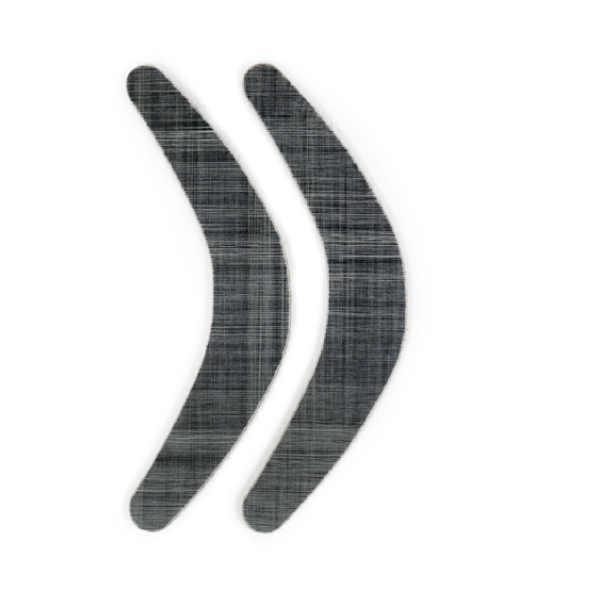
Xstal Alexandra AFO Boomerangs for Orthotic Strengthening
Moldable high-strength composite stiffener inserts to be incorporated into an AFO.
Increase resistance to bending forces.
Improve load distribution across the orthotic frame.
Support consistent alignment during gait.
Sold: Pair
Incl. VAT Exl. VAT
Product Description
Xstal Alexandra AFO Boomerangs
High-strength composite stiffener inserts designed to reinforce ankle-foot orthotics (AFOs) and enhance overall structural stability.
Best for: Reinforcing custom or prefabricated AFOs requiring added rigidity and long-term structural support.
Not ideal for: Use as a standalone orthotic device or in applications where flexibility is required.
- 1.9mm low-profile composite construction
- Boomerang shape for targeted AFO reinforcement
- Supplied in pairs for balanced application
What is it?
The Xstal Alexandra AFO Boomerangs are precision-formed composite inserts developed specifically for integration into ankle-foot orthotic devices. Their distinctive boomerang shape is engineered to provide structured reinforcement along key load-bearing areas of an AFO.
Manufactured from high-strength composite material, these inserts are designed to improve the rigidity and durability of orthotic systems used to support foot and ankle alignment. At just 1.9mm thick, they offer substantial reinforcement while maintaining a relatively low profile within the orthotic shell.
They are not an orthosis themselves. Instead, they act as structural components incorporated during fabrication or modification of an AFO to enhance performance characteristics such as stiffness, stability and resistance to deformation.
Who is it for?
Xstal Alexandra AFO Boomerangs are intended for orthotic practitioners, technicians and clinical teams involved in the manufacture or adjustment of ankle-foot orthoses.
They are particularly suitable when:
- An AFO requires increased rigidity to better control ankle movement
- A patient presents with significant instability requiring firmer support
- Long-term durability is a priority in high-demand users
- A custom orthosis needs additional structural reinforcement
End users may include individuals managing lower limb conditions where ankle stabilisation and controlled immobilisation are part of a treatment plan. These inserts support the orthosis in performing its intended function but should always be incorporated by a suitably trained professional.
What does it help with?
When integrated into an ankle-foot orthosis, these composite boomerangs may help enhance control and device performance in conditions such as:
- Foot drop → Supports improved dorsiflexion control by increasing AFO stiffness
- Ankle instability → Enhances mediolateral stability within the orthotic structure
- Gait abnormalities → Contributes to more consistent foot positioning during stance and swing phases
- Neuromuscular weakness → Reinforces orthotic integrity where sustained support is required
- Post-injury immobilisation → Helps maintain structured ankle positioning within the device
By strengthening the AFO shell, these inserts may reduce unwanted flexing or material fatigue over time, particularly in users with higher activity levels.
How does it work?
The performance of an ankle-foot orthosis depends heavily on its material properties and structural design. In some cases, thermoplastic or composite shells alone may not provide the level of stiffness required for optimal control.
The Xstal Alexandra AFO Boomerangs function as internal reinforcement elements. Once incorporated into the orthotic structure, they:
- Increase resistance to bending forces
- Improve load distribution across the orthotic frame
- Support consistent alignment during gait
- Enhance overall device longevity
The boomerang profile allows targeted reinforcement in areas subject to higher mechanical stress, without unnecessarily increasing bulk throughout the entire device. The 1.9mm thickness balances strength with practicality, helping maintain a streamlined orthotic form.
Expected Comfort & Use Timeline
Initial fitting
When incorporated into a newly fabricated or modified AFO, the device may feel firmer compared to a more flexible design. This is intentional and reflects the increased rigidity provided by the inserts.
Short-term adjustment (first few days)
Users may require a short adaptation period as they adjust to a more supportive orthotic structure. Clinical guidance should be followed regarding gradual wear if indicated.
Ongoing use (weeks and beyond)
Over time, the reinforced AFO is designed to maintain its structural characteristics. The composite construction helps preserve stiffness and reduce material fatigue, supporting consistent performance during prolonged treatment plans.
Problem → Solution
| Common problem | How the product helps |
|---|---|
| AFO feels too flexible during walking | Adds rigidity to improve structural control and reduce unwanted bending. |
| Device loses stiffness over time | Composite material is designed for long-term durability and resistance to fatigue. |
| Insufficient ankle stability | Reinforces key load-bearing zones to support better alignment. |
| Need to strengthen a custom orthosis | Can be incorporated into both custom-made and prefabricated AFO designs. |
| High-demand or active patient use | Provides robust reinforcement suited to repeated daily loading. |
Key Benefits
- High-strength composite construction for reliable reinforcement
- Low-profile 1.9mm thickness maintains practical orthotic form
- Boomerang shape designed for targeted structural support
- Suitable for custom and off-the-shelf AFO applications
- Designed for long-term orthotic use
- Supplied in pairs for balanced integration
Fit & Comfort Check
These inserts are intended to increase orthotic rigidity. The finished AFO should feel supportive and secure, but not painful or excessively restrictive.
After modification, check that:
- The orthosis fits snugly without creating pressure points
- There is no skin irritation during initial wear
- Footwear remains compatible with the reinforced device
If discomfort persists, reassessment by a qualified practitioner is recommended. Reinforcement should enhance support, not compromise comfort.
Common Mistakes to Avoid
- Using the inserts as a standalone support rather than as part of a professionally fabricated AFO
- Assuming increased rigidity will suit every patient or condition
- Over-reinforcing an orthosis where controlled flexibility is clinically appropriate
- Neglecting to review footwear compatibility after structural modification
How to Use
- Assess the patient’s clinical requirements and confirm that additional AFO rigidity is appropriate.
- Select the appropriate orthotic design and determine placement of the reinforcement inserts.
- Incorporate the Xstal Alexandra AFO Boomerangs into the orthotic structure during fabrication or modification.
- Ensure edges and integration points are properly finished to avoid internal friction.
- Fit the completed AFO and assess alignment, comfort and gait function.
- Provide user guidance on wear schedule and follow-up review if required.
Technical specifications
| Product name | Xstal Alexandra AFO Boomerangs |
|---|---|
| Product type | Composite reinforcement inserts for ankle-foot orthotics |
| Thickness | 1.9mm |
| Material | High-strength composite |
| Shape | Boomerang profile for targeted reinforcement |
| Compatibility | Suitable for custom and prefabricated AFOs |
| Pack contents | Sold in pairs |
| Care | Maintenance follows the care protocol of the finished orthotic device |
Frequently Asked Questions
Are these inserts suitable for all AFO designs?
They are designed for integration into many custom and prefabricated AFOs. Suitability depends on the orthotic design and clinical objective, and should be assessed by a qualified professional.
Can they be used in flexible orthoses?
They are intended to increase rigidity. In cases where flexibility is required, alternative reinforcement strategies may be more appropriate.
Will they make the AFO uncomfortable?
When correctly incorporated, the finished orthosis should feel supportive rather than uncomfortable. Proper fitting and finishing are essential to minimise pressure points.
Are they left and right specific?
They are supplied in pairs to allow balanced integration into an orthotic design. Final configuration depends on fabrication requirements.
Do they replace the need for a custom AFO?
No. These inserts are components used within an AFO. They do not replace the need for appropriate orthotic assessment, design and fitting.
How long do they last?
The composite construction is intended for long-term orthotic use. Longevity depends on patient activity level, device design and overall maintenance.
Complementary Products
For a complete orthotic solution, these reinforcement inserts may be paired with:
- Thermoplastic materials for AFO fabrication
- Orthotic joint components and hinges
- Padding and lining materials for pressure management
- Strapping systems for secure suspension
- Foot orthoses used in conjunction with ankle support devices
Written by: Algeos Product & Clinical Content Team
Last reviewed: March 2026
This content is provided for buyer guidance and product understanding. It is not a substitute for clinical assessment, diagnosis or medical advice. Orthotic design and modification should be carried out by appropriately trained professionals.
Frequently bought together
Sold: Each
Incl. VAT Exl. VAT
Sold: Pack of 25
Incl. VAT Exl. VAT
Sold: Sold Individually
Incl. VAT Exl. VAT
Sold: Each
Incl. VAT Exl. VAT
Sold: Sold Individually
Incl. VAT Exl. VAT
Sold: Sold Individually
Incl. VAT Exl. VAT
Sold: Sold Individually
Incl. VAT Exl. VAT
Sold: Pack of 5 Straps
Incl. VAT Exl. VAT
Sold: Pack of 10
Incl. VAT Exl. VAT
Sold: Each
Incl. VAT Exl. VAT
Sold: Each
Incl. VAT Exl. VAT
Sold: Kit
Incl. VAT Exl. VAT


Sold: Pair
Incl. VAT Exl. VAT