




This guide presents a structured, clinically-informed but accessible overview of compression socks. It is designed for healthcare professionals and informed consumers seeking a deeper understanding of their function, selection and use.
Definition
Compression socks are close-fitting hosiery garments designed to apply external pressure to the lower limbs - ankles, feet and calves - in a controlled manner, thereby supporting venous return, reducing fluid accumulation and alleviating leg fatigue. They are not intended to serve as medical devices for treating serious vascular disease unless prescribed or supervised by a clinician.
How They Work – Why They Matter
The primary mechanism of compression hosiery lies in what is commonly called “graduated compression”. This means the pressure is highest at or just above the ankle and declines progressively toward the calf.
By compressing the superficial veins and underlying tissues, the hosiery reduces vein diameter, increases flow velocity and supports the function of venous valves - thereby helping to move blood and interstitial fluid back toward the heart and reducing pooling in the lower limbs.
Mechanically, the external squeeze helps counteract gravitational forces and the decreased muscle pump activity that occurs during prolonged standing or sitting. Evidence from physiological and biomechanical studies confirms that even modest external pressure can measurably reduce venous distension and improve haemodynamics in the lower limb.
From a clinical perspective the relevance is twofold: (1) reducing leg swelling, heaviness and fatigue in everyday settings (e.g. standing all day, long flights, pregnancy) and (2) supporting venous health in more challenging scenarios (e.g., mild chronic venous insufficiency, post-surgical recovery).
While compression socks are not a treatment for major vascular pathology in themselves, they can serve as a useful adjunct in many leg-comfort and circulation-support contexts.
It is important to note that when the underlying clinical indication is high-risk (for example deep-vein thrombosis prophylaxis, or significant venous disease) the role of over-the-counter compression socks may be limited and should be considered within the context of a clinician’s assessment and other therapies.
Several recent trials in surgical patients have raised questions about the additive benefit of standard compression-hosiery in high-risk thrombosis prevention. Ref
What Users Say
Feedback from everyday users highlights a few common themes: a noticeable reduction in ankle and foot swelling at the end of a long day; less leg tiredness; a sense of lightness; and quicker recovery after long travel or extended standing. Many describe the socks as ‘silent helpers’ - not dramatic, but subtly beneficial once taken up.
Some users caution that a poor fit (too tight, too loose, or slipping) markedly diminishes benefits or introduces discomfort.
From a clinical-observer perspective these reported benefits align plausibly with the mechanistic evidence, though they are mostly anecdotal rather than derived from large-scale consumer studies.
Step-by-Step Guide
- Assess need – Consider whether the individual stands or sits for prolonged periods, travels, is pregnant, has mild leg swelling or feels leg fatigue. If there is a significant vascular condition (e.g. peripheral arterial disease, active ulceration, recent thrombosis) consult a clinician.
- Select type and size – Choose appropriate height (see below), measure calf circumference and shoe size, and refer to the manufacturer’s sizing chart. For wider calves or higher muscle bulk, consider “wide-calf” or “extended-fit” versions.
- Choose height – Options typically include ankle/quarter-length, crew/mid-calf, and knee-high. Match length to the goal (travel, all-day standing, casual use) and clothing/shoe style.
- Choose material and compression level – Materials vary (merino wool, cotton blends, nylon-elastane). Compression strength is commonly expressed in mmHg (millimetres of mercury). For everyday support a mild to moderate level may suffice; for more intensive support a higher level (or prescription grade) may be indicated. Ref.
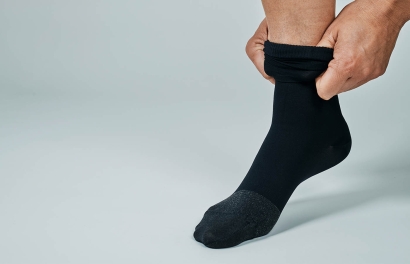
- Putting them on – Sit in a chair, roll the sock down to the heel pocket, insert foot ensuring heel sits in the heel pocket, then gradually roll/pull the sock up the leg, smoothing out creases and avoiding bunching or folding at the top edge. Best applied in the morning before swelling has increased.
- Wearing schedule – Use during the active part of the day when legs are upright or moving. Typical comfortable wear time is around 8-12 hours. Remove at night unless advised otherwise by a clinician.
- Care and replacement – Follow washing instructions; note that compression efficacy gradually declines with fabric ageing and use. Many users find replacement every 6-12 months appropriate for daily use.
Comparison Table: Compression Sock Features
| Feature | Considerations | Implications for Use |
|---|---|---|
| Compression strength (mmHg) | Light (15–20), Moderate (20–30), Firm (>30) | Higher strength may support more significant swelling or venous symptoms - ensure comfort and fit. |
| Sock height | Ankle/quarter, Crew/mid-calf, Knee-high | Knee-high gives greatest leg coverage/support; ankle or crew may suit less intensive use or casual shoes. |
| Calf fit/width | Standard, wide-calf, extended-calf | Adequate width prevents tightness, constriction or rolling down - promotes comfort and compliance. |
| Material blend | Wool (merino), Cotton blends, Nylon/Elastane, Technical synthetics | Choose material based on climate, comfort, skin sensitivity and durability requirements. |
| Seam & cuff design | Flat seams, non-binding tops, reinforced heel/toe | Enhances comfort, reduces risk of pressure marks or skin irritation - important in long-wear scenarios. |
Everyday Benefits
When selected and worn correctly, users may experience:
- Reduced ankle and foot swelling by day end.
- Less leg fatigue after prolonged standing, sitting or travel.
- Improved comfort during pregnancy, especially later stages when leg heaviness is common.
- Enhanced recovery from exercise, particularly for those who stand or move less after exertion.
- A general sense of “lighter” legs and fewer complaints of achiness in background wear.
These effects are generally modest but meaningful in daily life and are best viewed as supportive rather than curative.
Who Can Wear Them?
Compression socks are suitable for a broad range of individuals including:
- Persons who stand for long periods (e.g. retail staff, teachers, healthcare workers).
- People engaged in long-distance travel (flights, trains, car journeys).
- Expectant mothers experiencing leg swelling and heaviness.
- Individuals recovering from mild exercise or seeking everyday support.
- Anyone desiring comfortable leg support to complement daily activity.
However, caution is warranted for individuals with conditions such as significant peripheral arterial disease, uncontrolled cardiac failure, skin breaks/open sores, or severe neuropathy - these users should consult a clinician before regular use.
When to Give Your Legs a Break
Whilst compression socks are generally safe for day-time use in healthy individuals, discontinuation or reassessment may be needed if:
- Your legs feel numb, tingly or show persistent red marks or indentations after removal.
- You develop skin irritation, blistering, broken skin or open sores under the hosiery.
- You are advised by your clinician to pause use (for example in case of acute infection, leg ulceration or circulatory changes).
They should never cause pain or significant discomfort. If they do, the fit or strength may be inappropriate or a medical review is needed.
When and How Long to Wear Them
The most effective wear-times correspond to when the legs are upright or under positional stress (standing/sitting). Ideal use includes:
- During a full day at work (especially if standing or moving frequently).
- During travel involving prolonged sitting (airline, car, train).
- During a workout recovery phase when legs may feel heavy or swollen.
- During pregnancy when leg circulation is challenged.
Wear for around 8-12 hours is typical for comfort and efficacy. Remove at night unless your clinician advises overnight use for a specific indication.
Frequently Asked Questions
- Do compression socks really work?
- Yes - there is biological and physiological evidence that graduated external compression supports venous return, reduces venous pooling and can reduce swelling or leg fatigue, particularly in upright or sedentary positions.
- Are they safe to wear daily?
- For most healthy users yes - daily use is generally safe provided the socks fit correctly, feel comfortable and you have no contraindicated conditions. If you experience discomfort, numbness or skin signs you should reassess fit or seek clinician advice.
- Can I wear them overnight?
- Unless recommended by a clinician for a specific medical indication, wearing them overnight is usually unnecessary since gravity-related pooling is minimal when supine. Some clinicians recommend removal at night to allow the skin to breathe.
- Do they help during pregnancy?
- Yes. Many expectant mothers benefit from compression socks to mitigate leg swelling and heaviness, particularly in the second and third trimesters. Choose a suitable compression level and ensure fit remains comfortable.
- Do I need a prescription?
- For everyday support use you typically do not need a prescription p many over-the-counter options are available. However if you have a diagnosed vascular condition (e.g., deep-vein thrombosis, severe venous insufficiency) you should follow clinician guidance which may include prescription-grade hosiery.
- How long will they last?
- Fabric and compression resilience reduce over time. For users wearing them daily, many manufacturers and clinicians recommend replacing the pair every 6–12 months (or earlier if the fit loosens, the fabric thins or support feels reduced).
- What is “graduated compression”?
- Graduated compression refers to the design where highest pressure is applied nearer the ankle and progressively less as it moves up the leg - a key design feature that optimises venous return and reduces pooling. This contrasts with uniform compression which may be less efficient for this purpose.
References & Research Sources
- Scenario: Compression stockings - Management. Clinical Knowledge Summaries (CKS) - National Institute for Health & Care Excellence (NICE) UK. Available at: https://cks.nice.org.uk/topics/compression-stockings/management/compression-stockings/
- Chassagne F, Badel P, Molimard J. Lower leg compression and its biomechanical effects on the soft tissues of the leg. arXiv 2020.
- Avril S, Drapier S, Bouten L, et al. Mechanical investigation of compression stockings and their effects on the human leg. arXiv 2009.
- GAPS Study: Davies AH, et al. Graduated compression stockings as adjuvant to pharmaco-thromboprophylaxis in elective surgical patients: randomised controlled trial. BMJ 2020;369:m1309.
- Mandavia DP, et al. The effectiveness of graduated compression stockings for prevention of venous thromboembolism: systematic review. SAGE Journals 2020
- Verywell Health. Do Compression Socks Really Work? Here’s What Experts Say. (VerywellHealth, 2023).
More on Algeos.com
Differences Between Everyday Socks and Diabetic Socks
When it comes to foot health, picking the right socks is very important. This is especially true for people with diabetes.
It is not required for all diabetics to wear diabetic socks. However, it is strongly advised for those with foot problems or a high risk of getting them.
Understanding Diabetic Foot Conditions
Diabetes is a chronic condition that affects millions worldwide. One of the lesser-known but significant complications of diabetes is the development of foot problems.
Top Tips for Diabetic Foot Care
Diabetic lower limb products and daily living aids. Includes diabetic insoles, monitoring and prevention solutions to ensure safe and healthy feet.
Sold: Pair
Incl. VAT Exl. VAT