




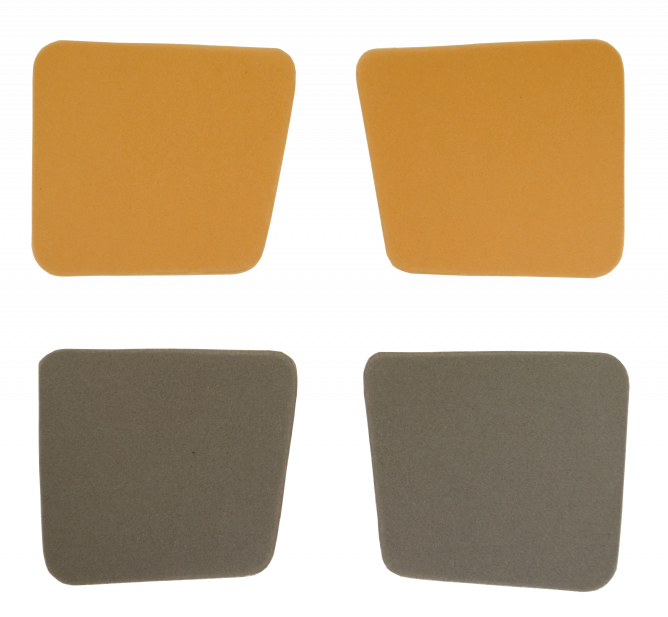
Convex Orthotic Forefoot Posting Wedges
Sold: 5 Pairs
Incl. VAT Exl. VAT
Product Description
High Density Convex Forefoot Orthotic Posting Wedges
Pre-cut, high density EVA wedges designed for precise forefoot posting in orthotic modification and clinical adjustment.
Best for: Podiatrists, orthotists, technicians, and clinicians modifying orthoses for forefoot alignment control.
Not ideal for: Direct-to-skin use or as standalone insoles without appropriate orthotic application.
- Convex shaped design for targeted forefoot posting
- High density EVA for structural support
- Colour coded by degree for quick identification
What is it?
Convex Forefoot Wedges are pre-formed, high density EVA posting components used in orthotic fabrication and modification. Each wedge is shaped with a convex profile and manufactured into a consistent wedged form, allowing clinicians and technicians to apply controlled angular adjustments to the forefoot section of an orthosis.
They are commonly used in custom orthotic labs, clinics, and footwear modification settings where precise posting is required to influence forefoot alignment and loading patterns.
Supplied in packs of five pairs, these wedges provide a practical stock solution for repeat clinical use.
Who is it for?
These wedges are designed primarily for professional use in orthotic and clinical environments. They are suitable for:
- Podiatrists adjusting custom orthoses
- Orthotists requiring controlled forefoot posting
- Foot health practitioners carrying out in-clinic modifications
- Orthotic laboratories producing or adapting devices
- Footwear modification specialists
They may also be used in training environments where students are learning orthotic adjustment techniques.
What does it help with?
Forefoot wedges are used as part of biomechanical management strategies. They do not treat conditions directly but are designed to support orthotic prescription goals.
- Forefoot alignment control: Helps introduce a measured angular correction within an orthosis.
- Load redistribution: Supports altered weight transfer across the forefoot.
- Orthotic fine-tuning: Allows incremental adjustment without remanufacturing the device.
- Clinical efficiency: Pre-cut form reduces preparation time.
- Consistency in posting: Manufactured wedge angles support repeatable application.
How does it work?
The convex shape allows the wedge to integrate smoothly into the forefoot section of an orthotic device. When applied beneath or within the orthosis, the wedged geometry introduces a controlled angular change, typically used to influence forefoot position relative to the rearfoot.
The high density EVA material provides structural integrity while maintaining workable properties. It can be bonded, ground, or blended as required within the orthotic fabrication process.
Colour coding allows quick visual identification of the posting angle:
- 3.5° – Grey
- 5° – Beige
This reduces selection errors in busy clinical or lab settings.
Expected Comfort & Use Timeline
During fabrication or fitting
The wedge is applied during orthotic manufacture or modification. Immediate structural change in the device can be observed once fitted.
Short term (initial patient wear)
Patients may require a short adaptation period when a modified orthosis is introduced. Gradual wearing schedules are typically recommended when changes to posting angles are made.
Ongoing use
When correctly prescribed and fitted, the wedge functions as a stable, long-term structural component within the orthosis. Regular review is recommended as part of standard orthotic follow-up.
Problem → Solution
| Common problem | How the product helps |
|---|---|
| Need to adjust forefoot alignment in an existing orthosis | Provides a pre-cut wedge that can be integrated without full device remanufacture. |
| Inconsistent hand-cut posting angles | Manufactured wedge angles support greater accuracy and repeatability. |
| Time-consuming orthotic modifications | Pre-formed design reduces preparation and shaping time. |
| Difficulty identifying wedge degrees quickly | Colour coding allows immediate recognition of 3.5° or 5° options. |
| Need for durable posting material | High density EVA provides firm, supportive structure. |
Key Benefits
- Pre-cut convex design for efficient forefoot posting.
- High density EVA for durable structural support.
- Colour coded degrees for fast clinical identification.
- Supplied in practical packs of five pairs.
- Suitable for bonding and integration into custom orthoses.
- Supports consistent, repeatable orthotic modifications.
Fit & Application Check
These wedges are intended for integration into orthotic devices, not for direct skin contact. Ensure the selected degree matches the prescription requirements before bonding. The wedge should sit flush within the orthotic structure without edge prominence.
Final finishing and blending should be completed to maintain patient comfort and device integrity.
Common Mistakes to Avoid
- Selecting an incorrect posting angle without reassessing biomechanical needs.
- Using the wedge without proper bonding or finishing.
- Applying as a standalone insole rather than as an orthotic component.
- Failing to review patient adaptation after modification.
How to Use
- Confirm required posting degree based on clinical assessment.
- Select the correct colour-coded wedge (3.5° grey or 5° beige).
- Prepare the orthotic surface for bonding.
- Position the wedge in the designated forefoot area.
- Bond securely using appropriate adhesive for EVA materials.
- Grind and blend edges as necessary for a smooth finish.
- Review fit and patient comfort during follow-up.
Technical specifications
| Specification | Details |
|---|---|
| Product type | Forefoot posting wedges |
| Shape | Convex |
| Material | High density EVA |
| Available angles | 3.5° and 5° |
| Colour coding | 3.5° – Grey; 5° – Beige |
| Pack size | Pack of 5 pairs |
| Application | Orthotic modification and fabrication |
Frequently Asked Questions
Are these suitable for direct use inside shoes?
No. These wedges are designed as orthotic components and should be integrated into a properly constructed device.
What material are they made from?
They are manufactured from high density EVA, selected for structural support and durability in orthotic applications.
How do I identify the angle quickly?
The wedges are colour coded: grey indicates 3.5°, and beige indicates 5°.
Can they be ground or shaped further?
Yes. As EVA components, they can be blended and finished as part of the orthotic fabrication process.
Are they reusable?
They are intended for permanent integration into an orthosis and are not designed for repeated removal and reapplication.
How many come in a pack?
Each pack contains five pairs, suitable for multiple orthotic applications.
Complementary Products
Convex Forefoot Wedges are commonly used alongside:
- Custom orthotic shells
- Rearfoot posting wedges
- Top cover materials and cushioning layers
- Orthotic adhesives suitable for EVA bonding
- Grinding and finishing tools for orthotic fabrication
Content Credibility
Written by: Algeos Product & Clinical Content Team
Last reviewed: February 2026
This content is intended for professional buyer guidance within orthotic and clinical settings. It does not replace individual biomechanical assessment or clinical judgement.
Sold: Sold per Pair
Incl. VAT Exl. VAT
Sold: Sold per Pair
Incl. VAT Exl. VAT
Sold: Pack of 10
Incl. VAT Exl. VAT
Sold: 5 Pairs
Incl. VAT Exl. VAT