




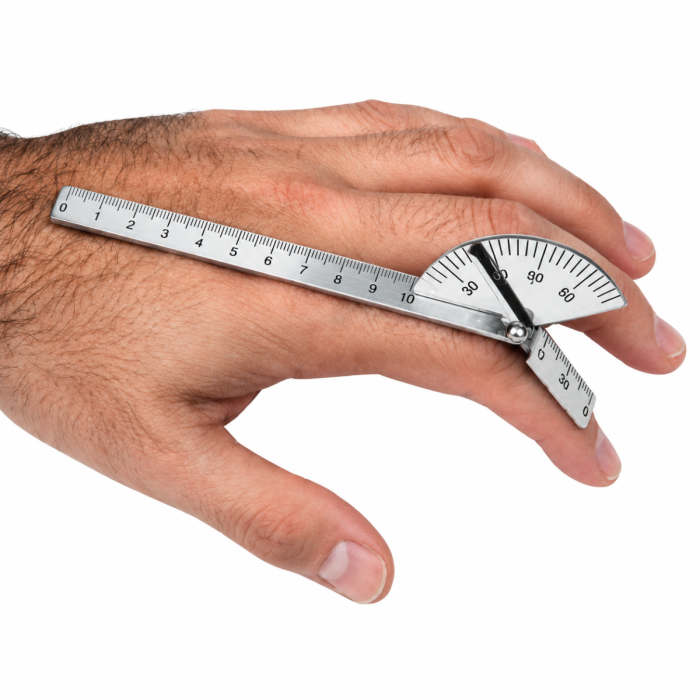
Baseline Finger Goniometer
A finger goniometer measures range-of-motion (ROM) of finger joints and other small joints including toes.

Product Description
Small Metal Finger Goniometer – 3.5 Inch
Measure finger and toe joint movement with a compact stainless steel goniometer designed for small-joint assessment.
The 3.5-inch Metal Finger Goniometer provides a practical way to measure joint range of motion (ROM) in degrees. Its compact design is particularly useful when assessing the smaller joints of the hands and feet, where a full-size goniometer may be less convenient.
Ideal for physiotherapists, occupational therapists, hand therapists, podiatrists and other healthcare professionals, this measurement tool can support initial assessments, rehabilitation reviews and the monitoring of changes in joint mobility.
With clearly graduated 5° markings and durable stainless steel construction, it provides a straightforward method of recording joint angles during routine clinical examinations.
Best suited to: Finger and toe joint assessment, hand therapy, rehabilitation monitoring and clinical range-of-motion measurements.
Key Selling Points
Measure Small-Joint Movement
Designed for recording the movement of finger joints and other small joints, including those of the toes.
Compact 3.5-Inch Size
Shorter arms make this model a practical choice for positioning around smaller anatomical structures.
Clear Degree Graduations
Opposing angular scales marked in 5° increments make joint angle measurements easy to identify and record.
Stainless Steel Construction
A robust metal instrument suited to repeated use in professional assessment environments when maintained correctly.
Supports Progress Monitoring
Record a baseline measurement and compare readings across follow-up assessments to help evaluate changes in mobility.
Simple Manual Operation
Uses a traditional pivoting-arm design without batteries, charging or electronic equipment.
What Does a Finger Goniometer Do?
A finger goniometer is a clinical measurement instrument used to determine how far a finger, toe or other small joint can bend or straighten.
Joint mobility is described as range of motion (ROM) and is normally recorded in degrees. Measuring this movement helps clinicians document joint function rather than relying on visual estimates alone.
How Does It Work?
The instrument has two arms connected by a pivoting measurement head. During assessment, the arms are aligned with the anatomical segments on either side of the joint being measured.
As the joint moves, the angle between the arms changes. The degree scale provides a reading that can be documented and compared during future assessments.
The small metal model has opposing 180° to 30° scales with markings at 5° intervals, allowing a range of small-joint positions to be assessed.
Why measure joint movement? Consistent measurements can help establish a starting point, identify movement restrictions and monitor whether mobility changes during rehabilitation or ongoing clinical management.
Common Problems It May Help Assess
A finger goniometer does not treat pain or stiffness. Instead, it helps measure changes in movement that may be associated with a range of hand and foot conditions.
Finger Stiffness
Measure restricted bending or straightening when stiffness affects everyday activities such as gripping, writing or handling objects.
Reduced Joint Mobility
Record the available movement at an individual finger or toe joint and identify differences between assessment sessions.
Post-Injury Movement Changes
Help clinicians monitor joint movement after an injury or period of immobilisation, when movement assessment is clinically appropriate.
Arthritis-Related Stiffness
Document restricted finger movement associated with arthritis as part of a wider assessment of hand function.
Joint Contractures
Measure and record limitations in joint extension or flexion during appropriate contracture assessment and management.
Toe Joint Restrictions
Assist with assessments of small toe joints where range-of-motion measurements are useful for podiatric or rehabilitation reviews.
Applications and Suitability
The small finger goniometer is primarily intended for professional or supervised joint assessment. It can be incorporated into clinical examinations and rehabilitation monitoring where objective movement measurements are required.
Typical Applications
- Hand therapy: Recording finger joint flexion and extension during assessment and rehabilitation.
- Physiotherapy: Monitoring small-joint movement following suitable treatment or exercise programmes.
- Occupational therapy: Measuring finger mobility when evaluating hand function and rehabilitation progress.
- Podiatry: Assessing movement at smaller toe joints as part of a wider foot examination.
- Clinical rehabilitation: Comparing initial and follow-up measurements to help document changes over time.
- Education and training: Demonstrating manual goniometry and small-joint measurement techniques.
Joints Commonly Assessed
- Metacarpophalangeal (MCP) joints at the base of the fingers.
- Proximal interphalangeal (PIP) joints in the middle of the fingers.
- Distal interphalangeal (DIP) joints near the fingertips.
- Suitable small joints of the toes.
Measurement should follow an appropriate clinical protocol, using consistent positioning and anatomical landmarks.
Who Is This Goniometer Not Suitable For?
Although useful for small-joint measurements, this compact instrument is not the best choice for every assessment.
- Larger joints: A longer goniometer may be more appropriate for measuring the knee, hip, shoulder and other larger joints.
- Unsupervised rehabilitation decisions: People without measurement training should not use readings alone to diagnose a condition or change treatment.
- Acute injuries or unstable joints: Movement testing should only be performed when clinically appropriate and should not override medical advice.
- Painful movement: Measurements must not involve forcing a joint beyond its comfortable or clinically permitted range.
- Damaged instruments: Do not use a goniometer if its markings are unclear, its movement is impaired or measurement accuracy is in doubt.
Product Specifications
| Product | Small Metal Finger Goniometer |
|---|---|
| Size | 3.5 inches (approximately 8.9 cm) |
| Construction | Stainless steel |
| Measurement Type | Joint range of motion (ROM) |
| Angular Scale | Opposing 180° to 30° scales |
| Scale Graduations | 5° increments |
| Linear Measurement | Inches and centimetres |
| Measurement Tolerance | ±1° for angular measurements |
| Primary Applications | Finger joints and other suitable small joints, including toes |
| Operation | Manual, pivoting-arm instrument |
| Product Reference | 12-1015 |
| Website SKU | PR0373 |
How to Use a Finger Goniometer
Correct positioning is essential when measuring finger or toe joint range of motion. The following steps provide a general overview of manual goniometry.
- Position the patient: Place the hand or foot in a stable, supported position suitable for the joint being assessed.
- Identify the joint: Locate the joint axis and relevant anatomical landmarks.
- Align the instrument: Position the goniometer's pivot and arms according to the chosen measurement protocol.
- Measure movement: Ask the patient to move the joint through the appropriate comfortable range, or assess passive movement when clinically indicated.
- Read the angle: Observe the degree scale without disturbing the instrument's alignment.
- Record the result: Document the angle, joint, side, movement direction, assessment position and whether movement was active or passive.
- Repeat consistently: Use the same assessment approach during later reviews to make comparisons more meaningful.
Clinical Measurement Tip
Maintain consistent patient positioning, joint alignment and measurement technique. Differences in positioning or examiner technique can affect results, so readings should be interpreted alongside the wider clinical examination.
Benefits of Using a Small Finger Goniometer
- More objective assessment: Express joint movement in degrees rather than relying only on visual observation.
- Better documentation: Record measurable findings in clinical notes, treatment plans and progress reviews.
- Practical for small joints: The shorter 3.5-inch format makes positioning around fingers and toes more convenient.
- Useful for repeated reviews: Compare movement measurements across assessment sessions.
- Supports patient communication: Demonstrate the amount of available joint movement in a clear, understandable format.
- Durable clinical construction: Stainless steel provides a robust alternative to plastic instruments.
- No electronic setup: Manual operation allows measurements without batteries, software or charging.
The main benefit is the ability to record small-joint movement consistently, helping clinicians monitor function and rehabilitation progress when measurements are performed appropriately.
Contraindications and Warnings
This instrument is intended to measure joint movement, not to provide treatment. Its use should always respect the patient's condition and any clinical movement restrictions.
- Clean and disinfect the instrument before and after each patient use, following an appropriate validated procedure.
- Check that all measurement markings are visible and legible before taking readings.
- Ensure the moving parts operate smoothly and are not damaged.
- Align the instrument with the correct anatomical landmarks.
- Apply gentle pressure and avoid forcing joints into painful positions.
- Stop immediately if movement produces pain or discomfort.
- Do not use the instrument if its accuracy has become compromised.
- Do not bend, modify or attempt to reshape the instrument.
Important: A goniometer measurement alone does not establish a diagnosis. New or worsening pain, significant swelling, suspected fracture or joint instability requires appropriate clinical assessment before range-of-motion testing.
Frequently Asked Questions
What is a finger goniometer used for?
A finger goniometer measures the range of motion of finger joints and other suitable small joints, including toes. It is commonly used during clinical assessments and rehabilitation reviews to record movement in degrees and monitor changes over time.
How does a finger goniometer measure joint movement?
The instrument has two arms connected by a pivoting head with angular markings. By aligning the arms with the relevant anatomical segments, the examiner can read the joint angle from the degree scale as the joint bends or straightens.
What is the difference between a 3.5-inch and a 6-inch finger goniometer?
The main difference is the length of the instrument. The compact 3.5-inch model can be easier to position around smaller finger and toe joints, while a 6-inch version provides longer arms that may be preferable for other measurement situations.
Can this goniometer measure both finger flexion and extension?
Yes, it can be used to measure finger joint positions during flexion and extension assessments when an appropriate measurement technique is followed. Correct alignment and consistent positioning are important for obtaining comparable results.
Can a finger goniometer be used for toe joints?
Yes, the instrument can also be used to assess range of motion in suitable small joints of the toes. This makes it relevant to podiatry assessments where recording joint mobility forms part of a broader examination.
Is a finger goniometer useful for arthritis assessments?
It can be used to record restricted joint movement associated with arthritis, including limitations in finger bending or straightening. However, it cannot diagnose arthritis, determine the cause of pain or replace a comprehensive clinical assessment.
Can it monitor progress after a finger injury?
Yes, range-of-motion measurements may help clinicians monitor mobility during appropriate rehabilitation following a finger injury or immobilisation. Testing should only take place when movement is permitted, and it must not force the joint beyond its safe range.
How accurate are the measurements?
The small metal model has degree markings in 5° increments, with a specified angular measurement tolerance of ±1°. Actual clinical measurements also depend on correct anatomical alignment, patient positioning and the technique used by the examiner.
Is this goniometer suitable for daily clinical use?
Its stainless steel construction and manual design make it practical for repeated routine assessment when correctly maintained. The instrument should be checked before use, cleaned and disinfected between patients, and replaced if damaged or no longer reliable.
Can patients use a finger goniometer at home?
Patients may be able to take measurements at home after being shown the correct technique by a healthcare professional. However, differences in positioning can affect readings, and measurements should not be used independently to diagnose a condition or make treatment decisions.
Related Products and Further Information
Explore other joint measurement instruments and assessment tools for clinical practice.
- Goniometers and Joint Angle Measurement Tools – Browse instruments for assessing joint movement and range of motion.
- Plastic Finger Goniometer – Flexion to Hyper-Extension – Explore an alternative finger-sized instrument for movement assessment.
- Goniometers for General Joint Measurement – View other goniometer options for clinical range-of-motion testing.
Product Summary
The Small Metal Finger Goniometer is a 3.5-inch stainless steel clinical measurement instrument designed to assess the range of motion of finger joints and other small joints, including toes. It features opposing 180° to 30° angular scales marked in 5° increments and a compact pivoting-arm design.
It is suitable for use by physiotherapists, occupational therapists, hand therapists, podiatrists and other trained healthcare professionals during joint mobility assessments, rehabilitation monitoring and clinical progress reviews. The instrument measures movement in degrees but does not diagnose or treat joint conditions.
Sold: Each
Incl. VAT Exl. VAT