



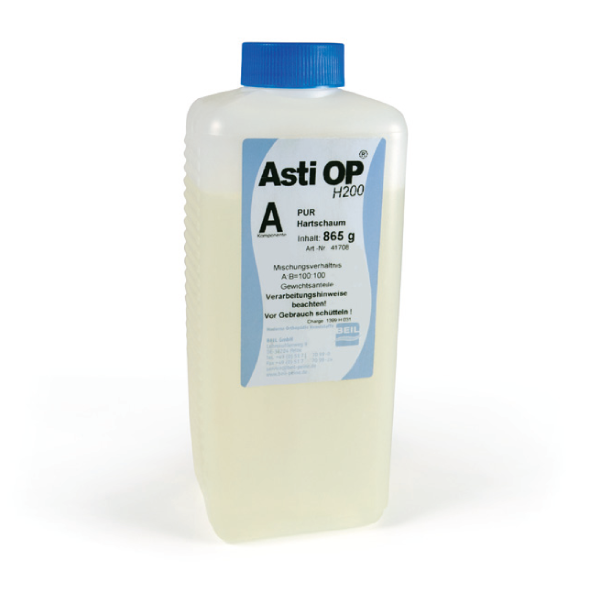
Asti OP H200 PUR Model Foam
Extremely lightweight, with a density of 200 kg/m³ and an expansion factor of around x 5.
ASTI-OP 200 is a suitable choice for less demanding applications where rigidity is still needed.
Foam for deep drawn models and cosmetic coverings in prosthesis construction.
Sold: Each
Incl. VAT Exl. VAT
Product Description
Lightweight PUR Model Foam
A proven two-component polyurethane model foam offering lightweight rigidity and reliable expansion for deep-drawn models and cosmetic prosthetic coverings.
Best for: Prosthetic workshops, orthotic labs and model makers requiring lightweight yet rigid foam for shaping and cosmetic applications.
Not ideal for: High-load structural components requiring very high-density or reinforced materials.
- Approx. 220 kg/m³ cured density
- Expansion factor approx. 5x
- Balanced price-performance ratio
What is it?
Asti OP H200 is a two-component polyurethane (PUR) model foam developed for technical model production and prosthetic fabrication. With a cured density of approximately 220 kg/m³ and an expansion factor of around five times its mixed volume, it delivers a lightweight yet stable structure suitable for workshop shaping and finishing.
This material has been proven in practice over decades and has undergone continuous refinement to ensure dependable processing and consistent results. It is positioned as a suitable option for less demanding structural applications where rigidity is still required but extreme load-bearing performance is not essential.
The foam is supplied as a two-part system (Component A and Component B) and must be mixed in a 1:1 ratio by weight to achieve proper foaming and curing characteristics.
Who is it for?
Asti OP H200 is intended for professional fabrication environments and technical users, including:
- Prosthetic technicians
- Orthotic laboratories
- Rehabilitation engineering departments
- Model and mould makers
- Educational institutions teaching prosthetic fabrication
- Industrial workshops requiring lightweight modelling foam
It is particularly relevant in prosthesis construction where lightweight bulk build-up and cosmetic shaping are required without excessive material weight.
What is it used for?
This PUR model foam is primarily used for creating deep-drawn models and cosmetic coverings within prosthetic construction. Its controlled expansion and moderate density make it practical for shaping, carving and finishing after curing.
Applications
- Deep-drawn models in prosthetic fabrication
- Cosmetic coverings for prostheses
- Lightweight core build-up
- Workshop prototypes and form models
- Less demanding rigid model applications
Characteristics
- Two-component polyurethane system
- Approximate cured density: 220 kg/m³
- Foaming factor: approximately 5x expansion
- Mixing ratio A:B = 100:100 parts by weight
- Extremely lightweight relative to solid modelling materials
- Rigid structure suitable for shaping and finishing
Typical Users
- Prosthetists constructing cosmetic limb covers
- Technicians preparing deep-drawn mould forms
- Orthotic workshops producing lightweight positive models
- Training facilities teaching foam modelling techniques
How to work with it
- Accurately weigh components A and B in equal parts by weight
- Mix thoroughly to ensure uniform reaction
- Pour into prepared mould or model cavity
- Allow to expand and cure fully before handling
- Trim, shape or sand as required once hardened
Expected Use Timeline
First use
Once mixed at the correct ratio, the material begins its foaming reaction. Working and setting times depend on workshop conditions such as temperature and humidity. Reference the manufacturer’s setting time table (see product images) for detailed guidance.
Ongoing use
After full curing, the foam forms a stable, rigid structure suitable for carving, sanding or cosmetic finishing. Long-term durability depends on the application, environmental exposure and mechanical demands placed on the finished component.
For structural or high-load requirements, a higher density material may be more appropriate.
Problem → Solution
| Common problem | How the product helps |
|---|---|
| Need for lightweight but rigid modelling material | Provides approx. 220 kg/m³ density with stable cured structure. |
| Excessive weight in cosmetic prosthetic build-ups | Low density and 5x expansion help reduce overall weight. |
| Inconsistent foam expansion | Defined 1:1 mixing ratio supports predictable reaction when measured accurately. |
| High material cost for large-volume models | Balanced price-performance ratio suitable for everyday workshop use. |
| Difficulty shaping dense solid materials | Foam can be shaped and finished after curing. |
Key Benefits
- Lightweight polyurethane foam with controlled expansion
- Approx. 5x foaming factor for efficient volume coverage
- Rigid cured structure suitable for shaping
- Suitable for deep-drawn models and cosmetic prosthetic coverings
- Proven formulation refined through long-term practical use
- Clear 100:100 by weight mixing ratio
Common Mistakes to Avoid
- Incorrect mixing ratio, which may affect expansion and curing
- Insufficient mixing leading to uneven foam structure
- Underestimating expansion volume and overfilling moulds
- Using for high structural load applications beyond its intended purpose
How to Work With Asti OP H200
- Prepare the mould or cavity, ensuring it is clean and dry.
- Weigh Component A and Component B accurately at a 100:100 ratio by weight.
- Mix thoroughly until uniform in appearance.
- Pour the mixture into the mould, allowing space for expansion.
- Allow the foam to expand and cure undisturbed.
- Once fully hardened, remove from mould if required.
- Shape, sand or finish according to workshop needs.
Technical specifications
| Specification | Details |
|---|---|
| Product name | Asti OP H200 PUR Model Foam |
| Material type | Two-component polyurethane (PUR) foam |
| Density (cured) | Approx. 220 kg/m³ |
| Foaming factor | Approx. 5x expansion |
| Mixing ratio | A:B = 100:100 parts by weight |
| Primary applications | Deep-drawn models, cosmetic prosthetic coverings |
| Setting times | Refer to setting time table in product images |
| Load suitability | Suitable for less demanding rigid applications |
| Colour | Varies by batch |
Frequently Asked Questions
Is this foam suitable for structural load-bearing components?
It is designed for less demanding applications where rigidity is required. For high-load structural components, higher-density or reinforced materials may be more appropriate.
What is the correct mixing ratio?
Component A and Component B must be mixed at a 100:100 ratio by weight.
How much does it expand?
The foaming factor is approximately five times the original mixed volume. Adequate allowance should be made in mould design.
Can it be shaped after curing?
Yes. Once fully hardened, it can typically be trimmed, carved or sanded according to workshop requirements.
Where can I find setting times?
Setting and processing times are provided in the product’s image section. Times may vary depending on ambient temperature and workshop conditions.
Is it suitable for cosmetic prosthetic coverings?
Yes. It is commonly used for cosmetic build-ups and deep-drawn models within prosthesis construction.
Complementary Products
- Release agents for mould preparation
- Plaster bandages and casting materials
- Mixing containers and digital scales
- Sanding and shaping tools
- Cosmetic finishing materials for prostheses
Written by: Algeos Product & Clinical Content Team
Last reviewed: February 2026
This content is provided for buyer guidance and product selection support. It is not a substitute for professional fabrication training or technical production advice.
Related Downloads
Frequently bought together
Sold: Each
Incl. VAT Exl. VAT
Sold: Each
Incl. VAT Exl. VAT
Sold: Each
Incl. VAT Exl. VAT
Sold: Each
Incl. VAT Exl. VAT
Sold: 25 yards (22.8 metres)
Incl. VAT Exl. VAT
Sold: Each
Incl. VAT Exl. VAT
Sold: 400ml
Incl. VAT Exl. VAT
Sold: Each
Incl. VAT Exl. VAT
Sold: Each
Incl. VAT Exl. VAT
Sold: Multiple Sizes
Incl. VAT Exl. VAT
Sold: Each
Incl. VAT Exl. VAT