




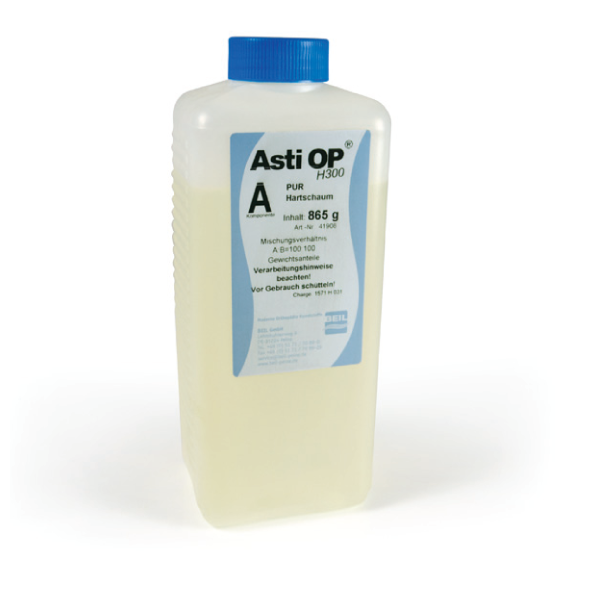
Asti OP H300 PUR Model Foam
Rigid polyurethane foam designed for creating deep drawn models and cosmetic covers in prosthetics.
Consistent density and expansion for reproducible modelling.
Stable closed-cell structure that supports accurate shaping.
Good dimensional stability for workshop processes.
Sold: Each
Incl. VAT Exl. VAT
Product Description
Rigid Polyurethane Model & Cosmetic Foam
High-quality rigid polyurethane foam designed for creating deep drawn models and cosmetic covers in prosthetic and orthotic workshops.
- Best for producing accurate foam models and cosmetic prosthesis surfaces
- Not ideal as final wearable prosthetic interface material
- Professional workshop and technical use
Expected Use
First use (immediately): Ensure proper personal protective equipment (PPE) such as gloves and eye protection before handling components. Mix A and B components in the correct ratio and follow workshop protocols for dispensing foam.
Short-term (first hours/days): Foam will expand and cure; handle gently during trimming and shaping. Expect a strong closed-cell rigid foam surface once fully set.
Ongoing use (weeks): Once cured and shaped, the foam remains dimensionally stable over time and suitable for repeated use in moulding and model work.
What is it?
Asti OP H300 PU Foam is a two-component rigid polyurethane foam system used in technical workshops to create deep drawn models and cosmetic coverings for prosthetic and orthotic fabrication.
The foam expands when mixed and cures into a stable closed-cell structure that can be cut, shaped, and worked to form positive models and moulds.
Who is it for?
This product is intended for experienced technicians, orthotists, prosthetists, and workshop professionals who require reliable rigid foam for model making. It is suitable for use in clinical workshop environments where precision and consistency in foam models matters.
What does it help with?
- Creating accurate foam prototypes for prosthetic socket design
- Forming cosmetic covers and shapes for final outer surfaces
- Building test models for deep drawing and shaping procedures
- Supporting workshops in trimming, fitting, and validation of form
How does it work?
The foam is supplied as two separate liquids (Component A and Component B) that are combined in equal parts by weight. Once mixed, a chemical reaction begins. The mixture expands (approximately tripling in volume) and cures into a rigid closed-cell foam with a density of about 320 kg/m³.
The cured material is stable, lightweight, and resistant to deformation, making it suitable for model fabrication and shaping.
Problem → Solution Table
| Common Problem | How Asti OP H300 PU Foam Helps |
|---|---|
| Need to create a stable model for prosthetic socket shaping | Provides a rigid foam base that can be trimmed and shaped precisely |
| Inconsistent foam quality affecting work accuracy | Proven formulation with consistent expansion and cure properties |
| Models deforming under light stress | Higher density cured foam resists deformation and holds shape |
| Difficulty forming cosmetic covers | Closed-cell structure supports clean surface finish and trimming |
Key Benefits
- Consistent density and expansion for reproducible modelling
- Stable closed-cell structure that supports accurate shaping
- Good dimensional stability for workshop processes
- Suitable for deep drawn model production
- Compatible with trimming, cutting, sanding, and shaping tools
- Easy to mix and use with standard workshop practices
Mistakes to Avoid
- Incorrect mixing ratio — always use equal parts A and B by weight
- Overfilling moulds — monitor expansion space carefully
- Not wearing appropriate PPE during handling
- Rushing trimming — allow full cure before shaping
How to Use
- Prepare workspace with protective surface covers and ventilation.
- Weigh equal parts of Component A and Component B (100:100 by weight).
- Pour both components into a clean mixing container and stir thoroughly to a uniform mix.
- Immediately pour the mixed liquid into the mould or form area, allowing room for expansion.
- Let the foam expand and cure. Wait until it does not feel warm and is fully set before demoulding.
- Trim, sand, or shape the cured foam as required for your model or pattern needs.
Technical specifications
| Specification | Detail |
|---|---|
| Material Type | Rigid Polyurethane Foam |
| Density (Cured) | Approximately 320 kg/m³ |
| Foaming Factor | Approximately 3.5 |
| Mixing Ratio | Component A:B — 100:100 by weight |
| Application | Model making and cosmetic covering |
| Form | Two-component liquid system |
| Cure Type | Chemical rigid foam |
FAQs
Q: Is this foam suitable for direct skin contact?
A: No. This foam is for creating models and covers in a workshop. It is not designed for direct patient contact. Always use fully cured foam for handling and shaping.
Q: Can I use this foam for wearable prosthetic liners?
A: No. This foam is too rigid for use as a liner. Use soft materials specified for patient interfaces.
Q: How long does curing take?
A: Cure time depends on ambient temperature and mix volume. Allow foam to fully harden before trimming or shaping.
Q: What safety precautions are necessary?
A: Always wear gloves and eye protection when mixing and pouring. Work in a well-ventilated area and allow foam to cure before extended handling.
Q: Can I use this with other workshop materials?
A: Yes. Once cured, the foam can be worked with standard workshop tools and combined with other shaping and finishing materials as needed.
Complementary / Pairing Suggestions
- Rigid foam mixing agent (Component B) — for consistent reaction control
- Workshop trimming and shaping tools — to refine cured foam shapes
- Protective surface covers — to maintain clean workspace during pour
- Sandpaper and finishing abrasives — for surface smoothing
Content Credibility
Written by: Algeos Product & Clinical Content Team
Last reviewed: January 2026
Purpose: Buyer guidance. Not intended as diagnosis or medical advice.
Related Downloads
Frequently bought together
Sold: Each
Incl. VAT Exl. VAT
Sold: Each
Incl. VAT Exl. VAT
Sold: Each
Incl. VAT Exl. VAT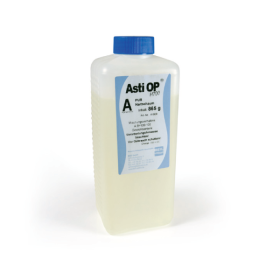
Sold: Each
Incl. VAT Exl. VAT
Sold: Each
Incl. VAT Exl. VAT