


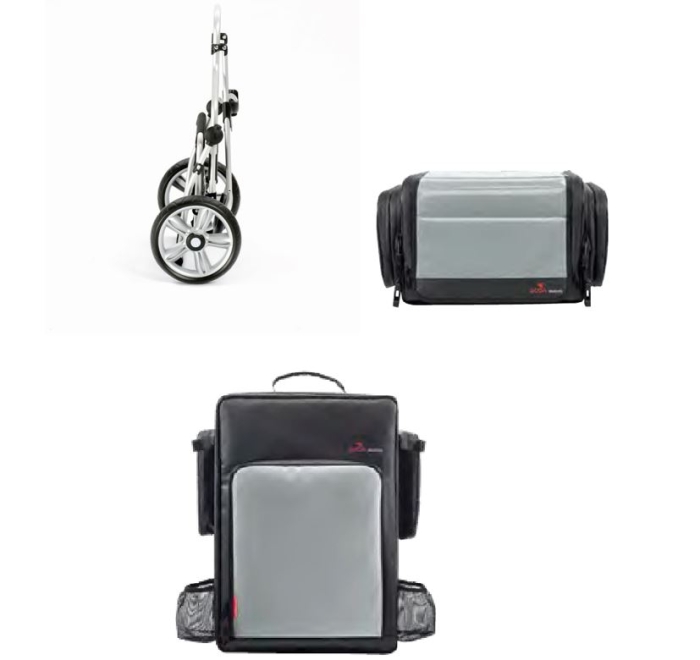
Mobile Working 2-wheel trolley Full Kit (bag + trolley)
Mobile Podiatry working unit brings transport, organisation and working access together in one portable kit.
Supports upright use during appointments, helping reduce unnecessary unpacking.
Two-wheel design makes regular travel more manageable for mobile clinicians.

Product Description
Portable Podiatry Clinic Trolley
A practical mobile working system designed to help foot care professionals transport, organise and use essential equipment efficiently during daily domiciliary and community visits.
- Best for: mobile podiatry, domiciliary foot care, community clinics, rural visits and practitioners needing a stable portable working setup
- Not ideal for: users seeking a compact handbag-style solution or a fixed clinic storage unit
- Combines trolley, supply unit and mobile working station in one kit
- Designed for upright working with organised access to essentials
- Robust two-wheel format suited to regular travel and uneven routes
What is it?
The Mobile Podiatry Working 2-Wheel Trolley - Full Kit is a portable clinical transport and working solution created for podiatrists, chiropodists and foot health practitioners who carry out treatments away from a fixed clinic.
Rather than functioning as a simple storage bag, it is designed as a complete mobile working unit that helps you bring key instruments, consumables and treatment essentials to patient visits in a more structured and manageable way.
For many practitioners, mobile foot care involves balancing organisation, portability and hygiene while travelling between homes, care settings and community locations.
This trolley is designed to support that workflow. It allows equipment to be transported securely, then used directly from the upright trolley once on site. That can help reduce repeated unpacking, improve access to supplies and support a tidier working routine during treatment sessions.
The two-wheel construction is especially useful where routes may include pavements, rural paths, uneven surfaces or frequent loading in and out of vehicles. A robust trolley format can make day-to-day transport more manageable, particularly when carrying a full kit of clinical items. The overall concept is practical: one system for moving, storing and presenting what you need for treatment.
Because it forms part of a modular mobile setup, it also supports a flexible way of working. Practitioners who regularly adjust their kit according to the type of visit, patient group or environment may find this especially useful. The trolley is intended to help mobile clinicians stay organised without relying on multiple separate bags or makeshift storage arrangements.
Who is it for?
This trolley is designed for professionals who provide foot care outside a permanent clinic room and need a reliable way to carry and access their working equipment. It is well suited to those who spend a significant part of the week travelling between patients or locations and want a system that supports both transport and treatment setup.
It is particularly relevant for practitioners whose visits involve carrying a broad selection of instruments, dressings, foot care consumables and protective items. Working from an upright trolley can help create a more structured routine, especially in settings where there may be limited surfaces, restricted space or the need to remain organised in front of patients.
- Podiatrists carrying out domiciliary visits
- Chiropodists working in community and residential care settings
- Foot health practitioners covering rural or uneven routes
- Clinicians who need a portable and more organised alternative to standard bags
- Practices seeking a practical mobile system for regular daily use
It may also suit healthcare professionals who value an easy-to-clean mobile solution and want to reduce the effort involved in transporting a full treatment kit from one appointment to the next.
What does it help with?
Mobile work can create practical challenges long before treatment begins. Carrying equipment, keeping items organised, protecting clinical supplies in transit and setting up efficiently at a patient’s location all affect how smooth the visit feels. This trolley is designed to support those real-world demands.
- Heavy or awkward kit transport: the wheeled format can reduce the strain of carrying supplies by hand
- Frequent travelling between visits: helps keep equipment grouped and easier to move
- Working in rural or uneven environments: designed for routes where surfaces may be less predictable
- Limited setup space in domiciliary settings: allows work directly from the upright trolley
- Keeping supplies organised: modular storage supports separation of instruments and consumables
- Maintaining a practical workflow: helps reduce repeated unpacking and repacking during the day
In everyday terms, it helps the mobile practitioner arrive better prepared, stay more organised during treatment and move on to the next visit with less disruption. That can support a calmer, more efficient working day, especially where multiple appointments are scheduled.
How does it work?
The trolley combines three useful functions into one piece of mobile equipment: transport, storage and working access. During travel, it acts as a robust carrying system for the supplies needed for treatment. Once on location, it can be positioned upright and used as the main working base, helping the practitioner access kit more easily.
The two-wheel design supports movement across everyday routes, while the trolley format helps distribute the load more practically than carrying everything by hand. This can be especially helpful on longer approach routes from vehicle to patient location, or where clinicians are moving repeatedly throughout the day.
The modular system is an important part of how the trolley works in practice. A modular arrangement can help users organise items by treatment type, frequency of use or hygiene workflow. For example, regularly used tools and consumables can be positioned for quick access, while reserve stock can remain stored more securely until needed. This makes the trolley a more adaptable solution than a single open compartment.
Its upright working concept also supports cleaner and more efficient setup. Rather than placing everything on the floor or searching through multiple bags, the practitioner can work from the trolley as a central access point. In small or unfamiliar environments, that can make a noticeable difference to day-to-day usability.
Expected use timeline
First use
On first use, most practitioners are likely to notice the convenience of having a single mobile system rather than several separate bags or cases. The trolley can make transport feel more controlled and may reduce the effort required to move a full working kit between locations.
Short-term use (first few days)
After several visits, users often develop their preferred internal layout and working order. This is usually when the modular design becomes more valuable, as the trolley can be arranged around personal workflow, treatment style and the most frequently used supplies.
Ongoing use (weeks and beyond)
With regular use, the main advantages are typically consistency, organisation and reduced day-to-day handling strain. An easy-to-clean, robust mobile unit can support a more repeatable routine across busy domiciliary schedules. Over time, this can help make mobile practice feel more efficient and less physically awkward.
Problem → Solution
| Common problem | How the product helps |
|---|---|
| Carrying multiple bags between visits is tiring and inconvenient | The trolley combines transport and storage in one wheeled mobile unit |
| Equipment is hard to organise during domiciliary work | The modular system helps separate and arrange supplies more clearly |
| Setting up in a patient’s home can be awkward | The upright trolley design allows direct access to equipment while working |
| Routes include rough pavements or rural surfaces | The robust two-wheel format is suited to regular travel on less even routes |
| Frequent unpacking slows down appointments | The trolley supports a more efficient workflow by keeping essentials accessible |
| Mobile equipment can be difficult to keep clean | The practical design is intended to support straightforward cleaning between uses |
Key benefits
- Brings transport, organisation and working access together in one portable kit
- Supports upright use during appointments, helping reduce unnecessary unpacking
- Two-wheel design makes regular travel more manageable for mobile clinicians
- Useful for rural, uneven or more demanding daily routes
- Flexible modular layout helps tailor storage to individual working habits
- Practical easy-clean design supports professional day-to-day use
Fit & comfort check
For the best day-to-day experience, the trolley should feel practical to move and stable to work from.
- Pack the heaviest items low and evenly where possible to improve balance
- The trolley should roll smoothly without feeling unstable or overfilled
- Frequently used supplies should be placed where they can be reached easily
- When working upright, the setup should feel organised and accessible, not cramped
- A well-packed trolley should support your workflow without encouraging overloading
In simple terms, the right setup should feel secure, efficient and comfortable to use across a full day of visits.
Common mistakes to avoid
- Overpacking the trolley with rarely used items, which can make daily transport harder than necessary
- Storing sharp instruments or delicate items without appropriate internal protection
- Using an unbalanced packing layout that affects rolling stability
- Expecting the trolley to replace all clinical infection control procedures rather than support good organisation
How to use
- Plan the day’s visits and select only the equipment, consumables and protective items needed for that schedule.
- Pack the trolley in a balanced way, placing heavier items securely and keeping frequently used items easy to reach.
- Check that instruments and supplies are organised in a clean, logical order before leaving for visits.
- Transport the trolley upright using the two-wheel system, taking extra care on steps, thresholds and uneven surfaces.
- At the treatment location, position the trolley where it can be accessed safely and conveniently during the appointment.
- Work directly from the upright trolley, removing only the items needed for the procedure.
- After each visit, return used or unused items to their correct sections and clean external surfaces as appropriate.
- At the end of the day, fully empty, clean and restock the trolley according to your usual clinical routine.
Technical specifications
| Specification | Details |
|---|---|
| Product name | Mobile Podiatry Working 2-Wheel Trolley - Full Kit |
| Product type | Mobile podiatry trolley and working unit |
| Wheel configuration | 2-wheel trolley format |
| Use context | Domiciliary podiatry, community foot care and mobile clinical visits |
| Working style | Designed to be used directly from the upright trolley |
| System format | Modular mobile working system |
| Primary benefit | Portable transport, organised storage and practical on-site access |
| Surface suitability | Intended to support daily travel including rural and uneven routes |
| Material details | Varies by component |
| Dimensions | Varies by configuration |
| Weight | Varies by kit contents |
| Colour options | Varies by option |
| Pack contents | Full kit configuration |
| Care and cleaning | Easy-clean design; follow normal professional cleaning procedures appropriate to the items stored and the working environment |
Frequently asked questions
Can this trolley be used as a working station during appointments?
Yes. It is designed to allow practitioners to work directly from the upright trolley, which can help improve access to essential supplies during mobile visits.
Is it suitable for rural or uneven routes?
Yes. The trolley is intended for regular mobile use, including environments where routes may be less even than typical indoor clinic settings.
Who is this trolley most suitable for?
It is best suited to podiatrists, chiropodists and foot health practitioners who perform regular domiciliary or community visits and need an organised portable working system.
Does the modular design matter in everyday use?
For many users, yes. A modular layout can make it easier to separate instruments, consumables and reserve stock, helping support a tidier and more efficient workflow.
Is it a good choice for daily use?
It is designed with daily mobile working in mind, especially for practitioners who want a more structured and robust alternative to carrying multiple bags.
Can it help reduce carrying strain?
The wheeled format may help reduce the physical effort of transporting a full working kit compared with hand-carrying equipment, although overall comfort will still depend on packing weight and route conditions.
Is it easy to clean?
The design is intended to be practical and easy to clean, which is important for clinicians working across multiple locations.
Complementary / pairing suggestions
This trolley is often most useful when combined with other product types that support an efficient mobile podiatry setup.
- Instrument trays and organisers for cleaner internal kit separation
- Sterilisation pouches and infection-control consumables for mobile workflow management
- Portable treatment packs for commonly used visit essentials
- Protective liners or cases for delicate podiatry instruments
- Single-use dressings, padding materials and clinical consumables suited to domiciliary work
- Compact portable lighting or examination accessories where treatment environments vary
Content credibility
Written by: Algeos Product & Clinical Content Team
Last reviewed: March 2026
This content is provided as buyer guidance to help practitioners assess product suitability for mobile podiatry work. It is not a substitute for professional judgement, risk assessment, training or clinical policy.
Frequently bought together
Sold: Each
Incl. VAT Exl. VATSold: Each
Incl. VAT Exl. VAT
Sold: Each
Incl. VAT Exl. VATSold: Each
Incl. VAT Exl. VAT
Sold: Each
Incl. VAT Exl. VAT
Sold: Each
Incl. VAT Exl. VAT
Sold: Each
Incl. VAT Exl. VAT
Sold: Each
Incl. VAT Exl. VAT
Sold: Each
Incl. VAT Exl. VAT