



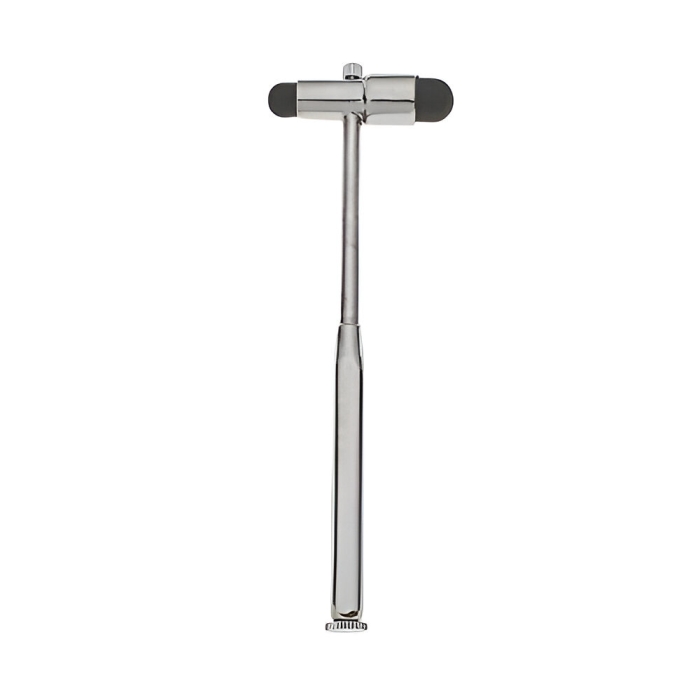
Buck Neurological Reflex Tendon Hammer
The classic clinical tool - the Buck Neurological Reflex Tendon Hammer.
Classic Buck reflex hammer design widely used in clinical practice.
Dual silicone mallet heads for versatile reflex testing.
Integrated removable needle and brush for sensory examination.

Product Description
Robust Construction Neurological Reflex Testing Hammer
A classic neurological reflex hammer designed for clinical reflex testing and nerve sensitivity assessment, featuring a balanced metal handle and dual silicone mallets.
Best for: Healthcare professionals performing neurological examinations, reflex testing and general physical assessments.
Not ideal for: Procedures requiring specialised percussion tools or heavy diagnostic instruments.
- Dual rubber heads for controlled reflex testing
- Integrated removable needle and brush for neurological assessment
- Balanced metal handle for accurate percussion
What is it?
The Buck Neurological Reflex Hammer is a diagnostic instrument used by healthcare professionals to evaluate reflex responses and nerve sensitivity during physical examinations. Reflex testing plays an important role in neurological assessment, helping clinicians observe how the nervous system responds to specific stimuli.
This reflex hammer follows the classic Buck design, which has been widely used in medical practice for decades. The instrument features a balanced metal handle with two differently sized silicone mallet heads. These allow clinicians to deliver controlled taps to specific tendons or reflex points while maintaining accuracy and consistency.
In addition to the percussion heads, the hammer includes a removable needle and brush integrated within the handle. These components support additional sensory testing during neurological examinations. The brush may be used to assess light touch sensation, while the needle can be used to evaluate pain sensitivity.
The combination of percussion testing and sensory tools makes the Buck reflex hammer a versatile diagnostic instrument suitable for a variety of clinical settings.
Who is it for?
This reflex hammer is designed for healthcare professionals who perform neurological or physical examinations as part of routine patient assessments.
Typical users include:
- Doctors and general practitioners
- Neurologists
- Podiatrists and foot health practitioners
- Physiotherapists
- Medical students and clinical trainees
- Healthcare professionals conducting physical examinations
Because reflex testing is commonly used in many medical disciplines, the Buck reflex hammer is a standard tool in clinics, hospitals, training environments, and examination rooms.
What does it help with?
The Buck Neurological Reflex Hammer supports the assessment of neurological function and sensory response. It is designed to assist clinicians in evaluating how the nervous system reacts to controlled physical stimulation.
- Tendon reflex testing: helps assess neurological reflex responses
- Nerve sensitivity evaluation: assists in identifying altered sensation
- Neurological screening: supports basic nervous system assessments
- Sensory examination: integrated needle and brush allow additional testing methods
- Clinical physical examinations: commonly used during routine patient evaluations
These assessments help healthcare professionals gather important diagnostic information about nerve pathways, muscle response, and neurological function.
How does it work?
The reflex hammer works by delivering a controlled percussion to specific tendons in the body. When the tendon is tapped with the hammer’s mallet head, the body produces an involuntary reflex response. Observing the strength, speed, and symmetry of this response helps clinicians assess nerve pathway function.
The Buck design incorporates two different mallet sizes. The larger head is typically used for stronger reflex points such as the knee tendon, while the smaller head allows more precise tapping in areas that require lighter percussion.
The balanced metal handle helps the clinician control the force and direction of each tap, allowing consistent testing across multiple reflex points.
The removable needle and brush extend the diagnostic capabilities of the instrument. The brush can be used to test light touch sensation across the skin, while the needle allows the clinician to evaluate pain response when required during sensory examinations.
By combining these features into one compact instrument, the reflex hammer supports multiple neurological assessment techniques within a single tool.
Expected Use Timeline
During examination: The reflex hammer allows healthcare professionals to perform quick neurological assessments as part of routine physical examinations.
Immediate results: Reflex responses occur instantly when the tendon is tapped, allowing clinicians to observe and record neurological reactions in real time.
Ongoing clinical use: Reflex hammers are durable diagnostic instruments that can be used repeatedly as part of standard patient assessments.
Proper technique and clinical training are important to ensure accurate interpretation of reflex responses.
Common Problems and How the Hammer Helps
| Common problem | How the product helps |
|---|---|
| Difficulty assessing neurological reflexes | Dual silicone mallets allow controlled percussion for reflex testing |
| Need to evaluate different tendon reflex points | Two mallet sizes provide flexibility for different testing areas |
| Multiple tools required for sensory examination | Integrated needle and brush support additional neurological tests |
| Inconsistent percussion force during testing | Balanced metal handle improves control and accuracy |
| Limited space in diagnostic kits | Compact design combines several diagnostic functions in one tool |
Key Benefits
- Classic Buck reflex hammer design widely used in clinical practice
- Dual silicone mallet heads for versatile reflex testing
- Integrated removable needle and brush for sensory examination
- Balanced metal handle supports controlled percussion
- Compact 18cm length suitable for clinical tool kits
- Durable construction designed for repeated professional use
The hammer should feel balanced and comfortable in the hand, allowing the clinician to deliver light, controlled taps during reflex testing. A relaxed grip typically provides the most accurate percussion and reduces unnecessary force during examination.
Common Mistakes to Avoid
- Applying excessive force when testing reflex responses
- Using the wrong mallet size for the reflex point being tested
- Failing to maintain hygiene between patient examinations
- Misinterpreting reflex responses without appropriate clinical training
How to Use the Reflex Hammer
- Hold the reflex hammer by the metal handle using a relaxed grip.
- Select the appropriate mallet size for the tendon being tested.
- Deliver a controlled tap to the tendon using a swinging motion from the wrist.
- Observe the reflex response and compare both sides of the body if needed.
- Use the integrated brush or needle for additional sensory testing when required.
- Clean the instrument according to clinical hygiene protocols after use.
Reflex Hammer Technical Specifications
| Specification | Details |
|---|---|
| Product type | Neurological reflex hammer |
| Design | Buck reflex hammer |
| Length | 18 cm |
| Handle material | Metal |
| Mallet material | Silicone / rubber |
| Testing heads | Dual mallet heads (large and small) |
| Additional tools | Removable needle and brush |
| Use | Neurological and physical examinations |
| Pack contents | 1 reflex hammer |
| Packaging | Sold individually |
Frequently Asked Questions
What is the Buck reflex hammer used for?
It is used during neurological examinations to test reflex responses and assess nerve function.
Why are there two rubber heads?
The two mallet sizes allow clinicians to test different reflex points with appropriate levels of percussion.
What are the brush and needle used for?
They allow additional sensory testing, such as evaluating light touch or pain sensitivity during neurological assessments.
Is this suitable for clinical training?
Yes. The Buck reflex hammer is commonly used in medical education and training environments.
How long is the hammer?
The instrument measures approximately 18 cm in length.
Is the hammer reusable?
Yes. It is a reusable diagnostic instrument designed for repeated clinical use when cleaned and maintained appropriately.
Complementary Products
This reflex hammer is commonly used alongside other diagnostic instruments that support neurological and physical examinations.
- Neurological examination kits
- Diagnostic penlights
- Monofilament sensory testing tools
- Clinical tuning forks
- Medical examination gloves
Content Credibility
Written by: Algeos Product & Clinical Content Team
Last reviewed: March 2026
This content is intended for buyer guidance and product understanding. It does not replace professional medical training or clinical diagnostic procedures.
Frequently bought together
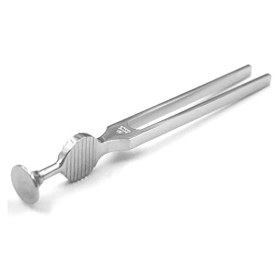
Sold: Each
Incl. VAT Exl. VAT
Sold: Each
Incl. VAT Exl. VATSold: Each
Incl. VAT Exl. VAT
Sold: Each
Incl. VAT Exl. VAT