



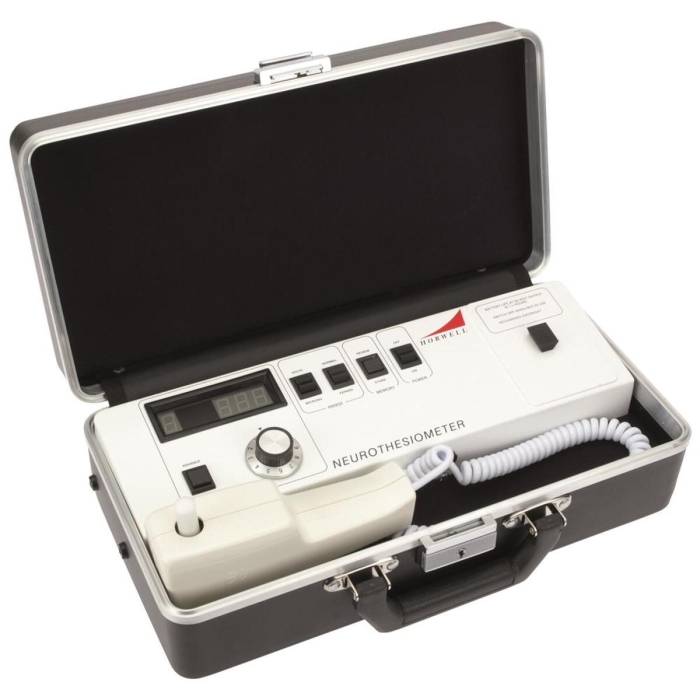
Neurothesiometer Neuropathy Tester
The Neurothesiometer is used for the determination of vibration sensitivity threshold at any desired site on the body surface.
Vibration sensitivity decreases naturally with age but a number of medical conditions can be related to abnormal deterioration.

Product Description
Neurothesiometer Neuropathy Tester
Neurothesiometer Applications
- Monitoring the progress of peripheral neuropathy which is associated with Diabetes.
- Observation of the reduction of vibration sensitivity in connection with other diseases.
- Routine recording of threshold sensitivity during podiatry leading to early diagnosis of disease or to susceptibility to conditions such as ulcers.
- The study of the effects of treatment on neuropathy and associated or causative conditions.
- Pharmacological and medical research projects involving relatively low costs.
Product Features
- Simple to operate.
- Rechargeable battery.
- Digital display of volts applied to the vibrator or free air movement of the vibrating head in microns.
- expansion. The voltage applied to the vibrator is adjusted by a rotary knob. The range may be switched normal = 0 to 50 volts/0-250 microns Expanded = 0 to 25 volts/0-62.5 microns.
- Ten memories which may be reviewed by switching from store to review.
- State of charge indication.
Technical Specifications
- Weight - complete instrument 3.25kg.
- Vibrator 450g.
- Dimensions - in closed carrying case L220mm x W370mm x H100mm.
- Length of vibrator cord 1m>
- Battery pack - life at 50V continuous output 1.25 hours.
- Life at 20V continuous output 1.75 hours.
Manufactured under BS 5750 Part 2 QAS34/51 (equivalent to ISO 9002 and EN29002). Conforms to BS 5724 Pt1 and medical standard IEC 601-1.
https://youtu.be/AIvhlAgcu5k
Chargers sold separately:
UK, USA, EU, South Africa and Australia available.
Usage Guide
Patient Preparation
- Explain the procedure and purpose to the patient.
- Ensure the patient is relaxed, seated or lying down comfortably.
- Remove footwear/socks if testing feet.
- Clean test site with alcohol wipe and allow to dry.
Test Sites
- Great toe (dorsal side)
- Medial malleolus
- Heel
- Finger pads (if applicable)
Test Procedure
A. Standard Range (0–10V / 0–25 microns)
- Ensure range switch is set to \"Standard.\"
- Place the probe gently but firmly on the test site.
- Begin increasing voltage slowly and steadily from 0 V.
- Ask the patient to say “yes” or raise a hand as soon as vibration is felt.
- Record the voltage at the first perception.
- Repeat three times at each site.
- Calculate and record the average VPT per site.
B. Expanded Range (0–25V / 0–62.5 microns)
Use only when:
No perception is reported at 10V after 3 attempts, OR
- Testing proximal or insensitive sites.
- Switch to Expanded Range.
- Repeat the steps above (same method).
- Document that the expanded range was used.
Interpretation Guide (Generalised)
VPT (Volts) |
Interpretation |
| <5 V | Normal |
| 5–10 V | Mild loss |
| 10–20 V | Moderate loss |
| >20 V | Severe neuropathy |
(Note: Refer to device-specific and population-specific norms when available.)
Frequently bought together
Sold: Each
Incl. VAT Exl. VAT
Sold: Each
Incl. VAT Exl. VAT