




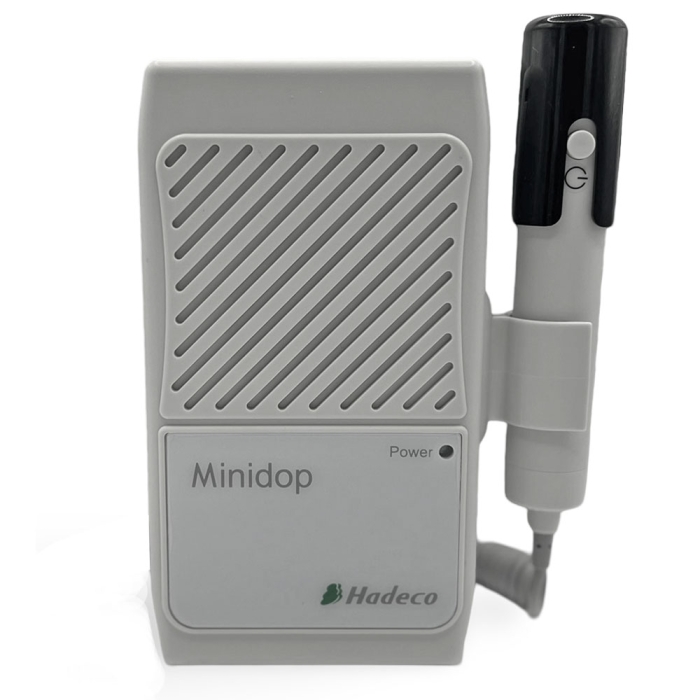
Minidop Pocket Diabetic Vascular Doppler - 8MHz

Product Description
Minidop ES-100VX Pocket Vascular Doppler - 8MHz
The Minidop ES-100VX is a hand-held pocket-size portable medical device, a useful tool for healthcare professionals in-clinic or for during domiciliary visits when assessing at-risk feet.
Compact and lightweight, quick and easy to use for professionals and patients alike.
Fully Compliant in UK and EU - don't accept cheap, dangerous and illegal devices.
Included in the box: 8 MHz Probe ideal for vascular assessment, a carry bag (for device and gel), 9V Batteries, ultrasound gel, batteries and a user manual.
Features & Benefits:
- Compact and lightweight, quick and easy to use.
- Wide selection of interchangeable probes
- Excellent reading for pedal pulses and systolic pressures
- High-sensitivity Doppler 8MHz probe, ideal for lower limb vascular assessment.
- Ergonomic design and Japanese technology.
- Audible speaker and headphone jack (headphones not provided).
- On/off/volume control switch.
- Class IIa Medical Device
- Dimensions: W7.8 x D14.1 x H2.7cm
- Weight: 240g
- 2 years warranty.
- Spare probes also available separately (2 MHz, 4 MHz, 5 MHz, 10 MHz or replacement of 8 MHz) are automatically recognised by the doppler.
- Made in Japan.
Technical Specification
Heart rate range: 50 - 240 bpm
Accuracy: +/- 2%
Audio Output for Earphone
Clinical Applications
- Peripheral vascular examinations
- Venous compressions
- Segmental blood pressure examination
- Systolic blood pressure from fingers, toes, penis
- Blood circulation monitoring
- Note to assess Foetal heartbeat monitoring a different MHz probe is required.
Measurement Values:
- Systolic, middle and diastolic speed
- Resistance
- Perfusion index
- Systoles/Diastoles (S/D) ratio
Clinical References:
Doppler ultrasound is probably the most widely used method for diagnosing vascular disease in the diabetic foot (Vowden, 1999; Leoniuk et al, 2014)
Leoniuk J, Lukasiewicz A, Szorc M, Sackiewicz I, Janica J, Lebkowska U. Doppler ultrasound detection of preclinical changes in foot arteries in early stage of type 2 diabetes. Pol J Radiol. 2014 Aug 29;79:283-9. doi: 10.12659/PJR.890486. PMID: 25202434; PMCID: PMC4156336.
The Minidop has been used in clinical studies, for example Prajapati et al, 2016 calculated the ankle brachial index (ABI) for the assessment of vasculopathy using the Minidop.
Prajapati, O. P.1,; Verma, A. K.1; Sharma, R. K.2; Sabaretnam, M.1. Renal Transplantation: Assessment of “at risk” Diabetic Foot and Recommendations for Mitigation. Saudi Journal of Kidney Diseases and Transplantation 27(5):p 893-901, Sep–Oct 2016. DOI: 10.4103/1319-2442.190780
NEWS 19Aug2025
Source: https://rcpod.org.uk/news
The Royal College of Podiatry (RCPod) has called for podiatrists in all clinical settings to have access to handheld Doppler devices and manual sphygmomanometers. These medical devices are critical for detecting PAD and CLTI.
Given the high prevalence of Peripheral Arterial Disease (PAD) and Chronic Limb Threatening Ischaemia (CLTI) among podiatrists' patients, the lack of timely vascular assessment poses serious risks to patient health, increasing the burden on NHS services.
Dopplers provide key diagnostic information allowing podiatrists to hear and quantify the quality of the blood flow through the arteries. When teamed with a sphygmomanometer, typically associated with monitoring blood pressure, key readings can be taken at the point of presentation; this increases the chances of early intervention for patients.
Frequently bought together
Sold: Each
Incl. VAT Exl. VAT
Sold: Each
Incl. VAT Exl. VAT
Sold: Each
Incl. VAT Exl. VAT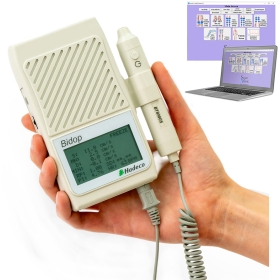
Sold: Each
Incl. VAT Exl. VAT
Sold: Each
Incl. VAT Exl. VAT
Sold: Each
Incl. VAT Exl. VAT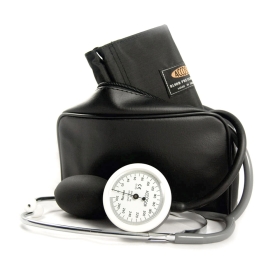
Sold: Each
Incl. VAT Exl. VAT
Sold: Each
Incl. VAT Exl. VAT
Sold: Kit
Incl. VAT Exl. VAT